



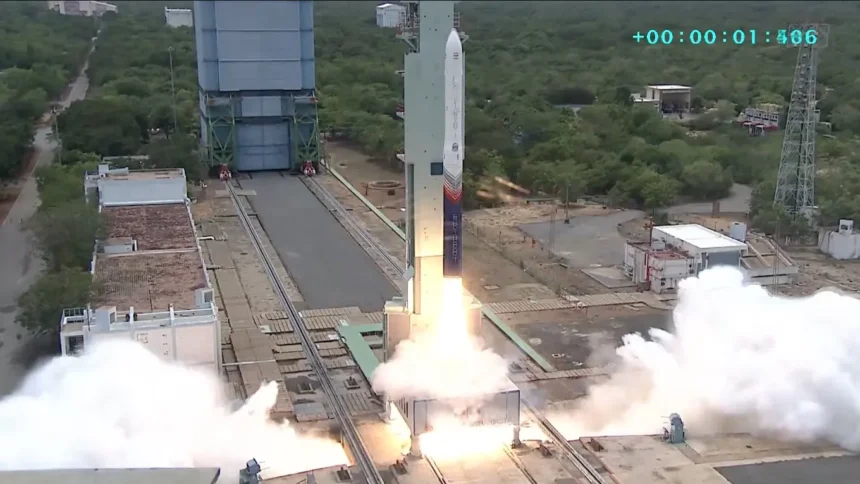
In a moment that will likely be remembered as a turning point for India’s commercial space industry, Skyroot Aerospace’s Vikram-1 rocket lifted off from the Satish Dhawan Space Centre on July 18 and successfully reached a planned 450-kilometer low Earth orbit just 15 minutes after launch. It was the vehicle’s maiden flight — and it worked.
That’s a rarity in the rocket business. Achieving orbit on a first attempt places Skyroot in rare company globally, and it sends a clear signal that India’s private space sector is no longer just aspirational. It’s operational.
Mission Aagaman: More Than Just a Test Flight
The inaugural mission, named Aagaman — meaning “arrival” in Hindi — carried two cubesats along with hosted payloads from multiple commercial partners. But perhaps the most symbolic cargo aboard was a collection of postcards bearing the signature of Prime Minister Narendra Modi, a detail that underscores just how politically charged this moment is for India.
Government backing matters in the early days of any commercial space market, and Modi’s personal involvement — even symbolically — reflects how seriously New Delhi is taking the development of a homegrown private launch industry. India has been deliberately dismantling regulatory barriers and opening its space sector to private players over the past several years, and Vikram-1’s success is exactly the kind of proof-of-concept that sustains that momentum.
A Rocket Built for the Small Satellite Economy
Vikram-1 is designed to carry payloads of up to 350 kilograms to low Earth orbit, putting it squarely in the small-to-medium launch vehicle category that has become one of the most competitive segments in the global space industry. Skyroot is already planning an upgraded variant, the Vikram-1U, capable of lifting 550 kilograms — a meaningful bump that could open the door to a wider range of commercial contracts.
The timing is deliberate. The small satellite market is booming, driven by demand from telecommunications, Earth observation, and IoT connectivity constellations. Launch providers that can offer reliable, affordable, and dedicated rides to orbit are in high demand, and Skyroot is positioning itself to compete for that business on a global scale.
Money, Momentum, and What Comes Next
Skyroot raised $60 million in a funding round in May, capital that will fuel its push toward full commercial operations. According to reporting from SpaceNews, the company plans to conduct up to two additional Vikram-1 launches before the end of 2025, using those missions to build flight heritage and refine operations ahead of a formal commercial rollout.
Flight heritage is currency in this industry. Satellite operators don’t hand over multi-million dollar payloads to rockets that haven’t proven themselves. Every successful launch Skyroot completes from here strengthens its hand when negotiating with potential customers who might otherwise default to more established Western or Asian providers.
The Bigger Picture for India’s Space Ambitions
India’s government space agency, ISRO, has long been respected for doing more with less — launching complex missions at a fraction of the cost of comparable Western efforts. The country now appears to be channeling that frugal engineering culture into a private sector ecosystem designed to compete internationally.
Skyroot is not alone. A handful of other Indian space startups are developing rockets and satellite systems, backed by both domestic venture capital and growing international interest. But Vikram-1’s successful orbital debut puts Skyroot at the front of that pack — for now.
Reaching orbit on a first flight doesn’t guarantee future success. Rockets have failed after strong starts, and the commercial launch market remains brutally competitive. But for India and for Skyroot, July 18 was the day the country stopped talking about having a commercial space industry and started proving it.