


### From Brain Waves to Words: Brain2Qwerty Offers a New Path to Communication Without Surgery
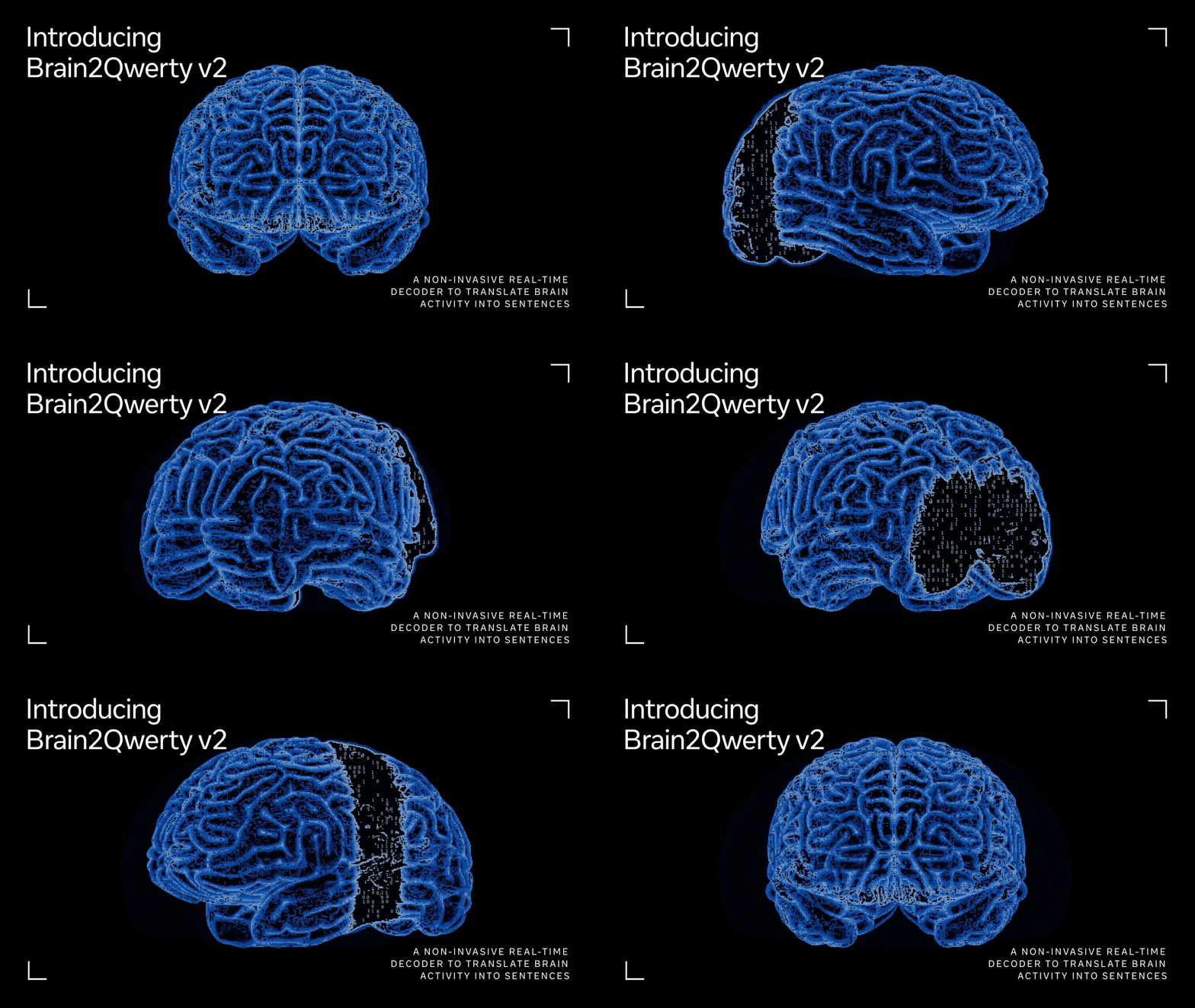
Last year, we unveiled v1 of our research that leverages AI to decode brain activity into text without any surgical implant. Now, we’re excited to share the next step with you: Brain2Qwerty v2, an end-to-end pipeline boasting real-time sentence decoding from non-invasive brain recordings, surpassing levels of accuracy previously reserved for techniques requiring invasive surgery.
To accelerate neuroscience breakthroughs and help those suffering from brain lesions that prevent them from communicating, we’re releasing the full training code for both Brain2Qwerty v1 and v2. Our partner, the Basque Center on Cognition, Brain, and Language (BCBL), is also making available their . This research has the potential to make a real difference.
Invasive procedures like stereotactic electroencephalography and electrocorticography have shown that feeding signals from a neuroprosthesis directly into an AI decoder can restore communication. However, these methods are difficult to scale. Our noninvasive approach aims to bridge this gap.
We trained Brain2Qwerty v2 on approximately 22,000 sentences from nine volunteer participants, each recorded for 10 hours while wearing a magnetoencephalography (MEG) device and actively typing. Unlike previous methods that relied on hand-crafted pipelines to detect neural events, we used end-to-end deep learning to decode directly from raw brain signals.
Fine-tuning large language models on neural data enables the system to leverage semantic context, bridging the gap between noisy brain recordings and coherent language. We deployed AI agents to explore optimizations for the decoding pipeline, selecting final training configurations manually by engineers.
The result: Brain2Qwerty v2 successfully recovers sentences from noisy neural inputs with remarkable coherence, achieving a word accuracy rate of 61%, significantly outperforming the 8% word accuracy from our previous version. For our best participant, we achieved an impressive 78% word accuracy, where more than half of all sentences are decoded with one-word errors or less.
We also found that decoding accuracy improves log-linearly with data volume, suggesting that the remaining performance gap with surgical approaches could be further narrowed through data scaling alone. This work contributes to our efforts to build open foundational models and pave the way for future breakthroughs in brain-computer interfaces (BCIs).
By providing access to full training code and sharing our research openly, we hope to accelerate innovation and collaboration within the neuroscience community. Let’s continue pushing boundaries together towards a world where communication is no longer hindered by physical limitations.
#Brain2Qwerty #AIInnovation #NeuroscienceBreakthrough #NonInvasiveTech #CommunicationRevolution #MedicalAdvancements #DecodingBrains