


In the smart glasses wars, Meta and Snap have placed their chips on cameras, AI capture, and ambient recording. Even Realities is betting that’s exactly the wrong move — and $150 million in new funding suggests some serious capital agrees.
The Shenzhen-based startup closed a pre-Series B round led by Meituan and Tencent this week, pushing its valuation to $1 billion just two years after founding. That’s a remarkable trajectory for a hardware company that didn’t exist in 2022, built around a product category littered with expensive failures.
The Camera-Free Thesis
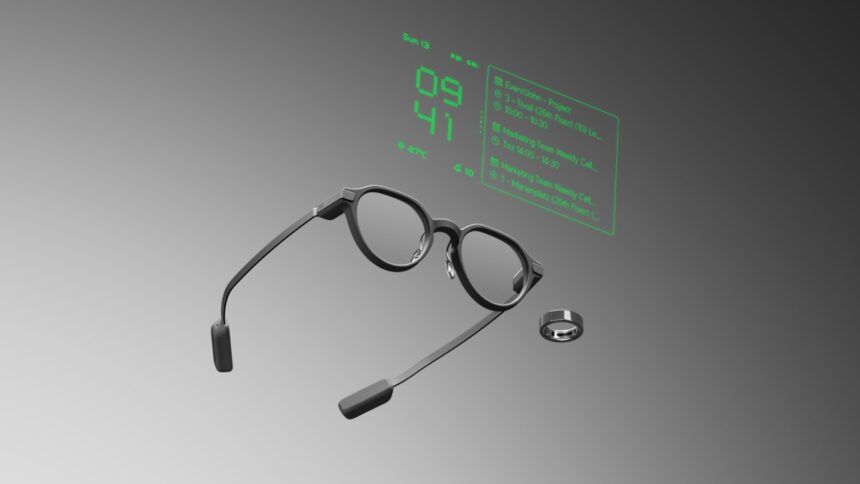
Even Realities’ flagship G2 glasses retail at $599 and deliberately omit a camera — the feature that defines almost every competitor’s marketing. CEO Will Wang, a former Apple engineer who worked on the Apple Watch and iPhone, frames the decision not as a compromise but as a core design principle.
“Smart glasses are probably the most personal computing device people will ever wear,” Wang has said, positioning privacy as foundational rather than bolted on. Voice features convert audio to text without storing recordings, and the company’s infrastructure is architected to satisfy European privacy regulations — a meaningful signal for a hardware maker whose primary growth market is the United States.
Instead of a camera, the G2 uses a heads-up display controlled by a companion wearable called the Even R1 ring. The full kit pushes average order value to approximately $1,000 when the ring or prescription lenses are included — a premium positioning that Wang claims hasn’t hurt momentum. He says the company is already profitable.
The Tech Stack Is the Moat
Even’s hardware ambitions go deeper than industrial design. The company developed proprietary optical technology it calls Even HAO — Holistic Adaptive Optics — which integrates the microchip, waveguide, and prescription lens support into a unified system rather than assembling off-the-shelf components.
Wang argues this integration is non-negotiable: “You have to design the microchip, the optics, and the waveguide together.” That philosophy mirrors what Apple did with silicon, and it’s the kind of vertical integration that’s genuinely difficult to replicate quickly. If it holds, Even’s optical stack could become a durable barrier to entry in a segment where most players are still buying components from the same suppliers.
Who’s Actually Buying
Even claims to be the first company in the smart glasses category to sell more than 10,000 pairs — a modest milestone by consumer electronics standards, but meaningful proof of demand in a space where hardware startups routinely announce and quietly disappear. More than half of its users are in the United States, its fastest-growing market. The company manufactures in China but does not yet sell there.
An internal survey found roughly one-third of Even’s customers are company executives. The core demographic skews toward male professionals aged 30 to 50 — exactly the segment that attends meetings, travels frequently, and has legitimate reasons to want real-time information without pulling out a phone.
Even’s AI assistant, called Conversate, reads conversations in real time to flag jargon, surface context, and suggest follow-up questions, then syncs summaries to the user’s phone afterward. It’s a workflow tool, not a social media accessory — which explains the enterprise-leaning user base.
A Market Splitting in Two
Even Realities grew from roughly 30 employees in 2024 to 300 to 400 today, according to reporting from TechCrunch. That pace of hiring signals genuine operational scaling, not just a paper valuation event.
The deeper story here is market bifurcation. Meta’s Ray-Ban glasses have normalized camera-equipped wearables. Snap keeps iterating on Spectacles. On the other side, Even is staking out a position where the display is the product and privacy is the pitch.
Backed by major Chinese tech investors while targeting Western markets exclusively, Even’s next phase will test whether premium, privacy-first hardware can scale against players with vastly larger distribution networks. The $1 billion valuation says the bet is live. Whether the market validates it is the question that makes the next 18 months worth watching closely.