



By using this site, you agree to the Privacy Policy and Terms of Use.
Accept
1CW - Ones Changing the World Logo 1CW - Ones Changing the World Logo
  • My Saved
  • My Bookmarks
  • Events
  • About Us
    • Contact
  • Advertise
Reading: The Mouse With a Almost-Human Brain: Stanford’s Chimera Breakthrough Rewrites Neuroscience
Share
Sign In
Notification
  • Future Tech
    • Artificial Intelligence
    • XR, VR, AR – XROM
    • Robotics & Automation
    • Blockchain
    • Quantum & Nanotechnology
    • Automotive
    Future Tech
    Future Tech explores breakthrough technologies shaping tomorrow’s world. From artificial intelligence to next-generation computing and immersive experiences, this section covers innovations that are transforming industries,…
    Show More
    Top News
    RayNeo × Warner Bros. Major Collaboration! RayNeo Air 4 Pro Batman Limited Edition Launches at 1,899 CNY
    March 31, 2026
    China Issued First National ID Card for AI Virtual Idol
    February 25, 2026
    Virtual Reality Theatre Set to launch at National Science Centre, Delhi
    March 7, 2026
    Latest News
    Lenskart Bets Bigger on XR With Third Stake Hike in AjnaLens Parent This Year
    September 15, 2026
    Lenskart Bets Bigger on XR With Third Stake Hike in AjnaLens Parent This Year
    September 15, 2026
    Flam Lands $40M Series B to Bring AI-Powered Brand Experiences to the Enterprise Mainstream
    September 15, 2026
    AI Is Solving Math’s Hardest Problems — But Missing the Point Entirely
    September 12, 2026
  • Science & Discovery
    • Life Sciences & Biotechnology
    • Health & Medicine
    • Earth & Environment
    • Space & Astronomy
    Science & Discovery
    Science & Discovery brings you the latest breakthroughs from research labs, universities, and space agencies. This section highlights discoveries expanding our understanding of life, health,…
    Show More
    Top News
    Exploring Space & Astronomy: How Modern Telescopes Are Revealing the Secrets of the Universe
    February 23, 2026
    Ai Med Agent
    The AI That Wears Your Eyes — and Walks Into the OR
    April 1, 2026
    How NASA and Modern Science Are Unlocking the Secrets of the Universe
    February 21, 2026
    Latest News
    Moderna’s mRNA Cancer Treatment Isn’t a Vaccine — It’s a Personalized Hit List for Your Immune System
    August 20, 2026
    Are We Turning Into Homo Deus? Dr. Aubrey de Grey and the Breakthroughs Redefining Human Longevity
    August 12, 2026
    From Brain Waves to Words: Brain2Qwerty Offers a New Path to Communication Without Surgery
    June 30, 2026
    A new generation of cell therapy developed by the EU-funded…
    June 30, 2026
  • Innovation & Industry
    • Startups & Entrepreneurship
    • Corporate Tech & Semiconductors
    • Telecom & Energy Tech
    • Policy & Economy
    Innovation & Industry
    Innovation & Industry focuses on business transformation, emerging companies, and the technologies driving economic growth worldwide.
    Show More
    Top News
    5G Rollout Accelerates Across Asia-Pacific and North America in 2026
    February 23, 2026
    AI-Driven Startups Raise Record Funding in 2026 Across Global Markets
    February 23, 2026
    Telecom Companies Explore Satellite Internet Expansion for Remote Areas
    February 23, 2026
    Latest News
    Moderna’s mRNA Cancer Treatment Isn’t a Vaccine — It’s a Personalized Hit List for Your Immune System
    August 20, 2026
    EssilorLuxottica, Lynx, and the Battle for AR’s Invisible Stack
    July 18, 2026
    NVIDIA ASPIRE: Agentic/Skills Discovery for Robotics
    July 1, 2026
    From Brain Waves to Words: Brain2Qwerty Offers a New Path to Communication Without Surgery
    June 30, 2026
  • Regions
    • India
    • North America
    • Europe
    • Middle East & Africa
    • China
    • Latin America
    • Asia-Pacific
  • 1CW Podcast
  • XROM Podcast
Reading: The Mouse With a Almost-Human Brain: Stanford’s Chimera Breakthrough Rewrites Neuroscience
Share
Font ResizerAa
1CW - Ones Changing the World1CW - Ones Changing the World
  • My Saved
  • Login
  • 1CW Podcast
  • XROM Podcast
Search
  • Future Tech
    • Artificial Intelligence
    • Blockchain
    • XR, VR, AR – XROM
    • Quantum & Nanotechnology
    • Robotics & Automation
    • Automotive
  • Science & Discovery
    • Earth & Environment
    • Health & Medicine
    • Life Sciences & Biotechnology
    • Space & Astronomy
  • Innovation & Industry
    • Corporate Tech & Semiconductors
    • Policy & Economy
    • Startups & Entrepreneurship
    • Telecom & Energy Tech
  • Regions
    • India
    • North America
    • Europe
    • Asia-Pacific
    • China
    • Middle East & Africa
    • Latin America
Have an existing account? Sign In
Follow US
  • About Us
  • Contact
  • Adverstise
  • Events
  • Join Us
  • Member Login
  • My Bookmarks
  • Terms
  • Privacy
1CW - Ones Changing the World > Blog > Uncategorized > The Mouse With a Almost-Human Brain: Stanford’s Chimera Breakthrough Rewrites Neuroscience
Uncategorized

The Mouse With a Almost-Human Brain: Stanford’s Chimera Breakthrough Rewrites Neuroscience

Eddie Avil
Last updated: September 17, 2026 3:56 AM
Eddie Avil - Co-Founder
Share
SHARE

For decades, neuroscientists have faced an uncomfortable truth: the mouse brain, despite its utility as a research model, is a poor stand-in for the human one. The cellular architecture is different. The disease progressions diverge. Treatments that work brilliantly in rodents routinely collapse in human clinical trials. Now, a team at Stanford University has taken a radical step toward closing that gap — by growing human brain tissue inside a living mouse.

Contents
  • More Than a Graft — An Integration
  • A Faster Path to Better Treatments
  • The Ethics Can’t Be an Afterthought

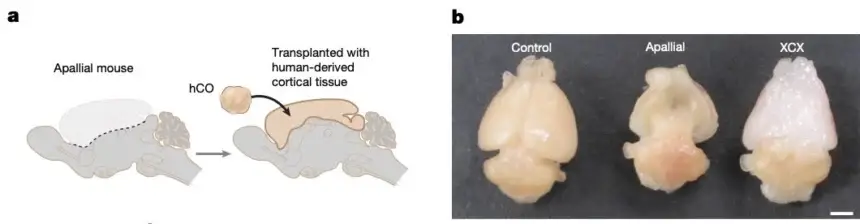
The research, led by neuroscientist Sergiu Pasca, involved transplanting human brain organoids — lab-grown clusters of neural tissue derived from human stem cells — into genetically engineered mice that had been modified to lack their own cortexes. The result was a new kind of animal the researchers call a xenocortical mouse: a creature whose cortical volume is composed of approximately 92% human-derived neural cells. That is not a typo. Nine out of ten neurons forming the outermost and most cognitively significant layer of the brain are, in meaningful biological terms, human.

More Than a Graft — An Integration

What separates this study from prior organoid transplantation experiments is the depth of biological integration achieved. Earlier work demonstrated that human neural tissue could survive inside a host animal. What Pasca’s team has shown is that it can thrive and function — connecting with the mouse’s broader nervous system, supporting organized neural activity, and influencing the animal’s behavior in measurable ways.

This is a crucial distinction. A transplant that simply sits inert inside a host tells researchers relatively little. A transplant that wires itself into circuits, fires in response to stimuli, and shapes how the animal acts? That is a functioning biological model — arguably the closest approximation of a living human cortex that science has yet produced outside a human skull.

The implications for disease research are substantial. Conditions like Alzheimer’s disease, schizophrenia, autism spectrum disorder, and treatment-resistant depression are notoriously difficult to study in traditional animal models precisely because they are so distinctly human in their pathology. A mouse engineered with largely human cortical tissue offers a platform where the disease mechanisms can unfold in biologically relevant cells — cells that behave as human neurons do, not as rodent approximations of them.

A Faster Path to Better Treatments

Drug development stands to benefit significantly. The pharmaceutical industry loses enormous resources testing neurological compounds that succeed in animal models only to fail in human trials. Xenocortical mice could serve as a more predictive intermediate stage — a biological bridge that filters out failures earlier and brings genuinely promising candidates forward with greater confidence.

This could be particularly transformative in psychiatry, where the molecular targets underlying many disorders remain poorly understood and where the translation from bench to bedside has historically been weakest. Having a model that more accurately reflects human neural circuitry could accelerate not just drug testing but fundamental discovery about how the human brain generates mood, cognition, and behavior.

The Ethics Can’t Be an Afterthought

Pasca’s team did not arrive at this research naively. Before conducting the work, the Stanford researchers engaged external ethicists to examine the moral dimensions of creating chimera animals with substantial human neural tissue. That proactive consultation deserves recognition — it reflects the kind of foresight the field needs as biotechnology accelerates into increasingly uncharted territory.

But the questions raised by this work will not be resolved by a single ethics consultation. If a mouse’s cortex is 92% human, what does that mean for its inner experience? Does it perceive the world differently? Could it suffer in ways a standard lab mouse cannot? These are not abstract philosophical puzzles — they have direct bearing on how such animals should be housed, studied, and ultimately treated under research ethics frameworks that were never designed with xenocortical animals in mind.

Science rarely waits for ethics to catch up, and this case is no different. What matters now is that the conversation keeps pace with the capability — and that researchers, regulators, and the public engage with the hard questions before they become urgent ones.

For now, the xenocortical mouse represents one of the most significant advances in neuroscience modeling in years. It is a tool that could genuinely help us understand and treat diseases that have resisted our best efforts for generations. That potential is worth pursuing — carefully, transparently, and with eyes open to what it means to blur the line between species in the seat of human identity itself.


Regrowing What’s Lost: Texas A&M Scientists Unlock a Path to Mammalian Limb Regeneration
Telegram Ban in India: A Misguided Response to Exam Leaks
Butterfly & Aleph Neuro Debut Brain Imaging Tech
Unreal Engine 5.8 is here: discover its 5 key features for CG artists | CG Channel
India and France Unite to Fuel Deep-Tech Innovation
TAGGED:brain chimera ethicshuman neural tissue graftshybrid animal consciousnessneurological disease researchStanford neuroscience breakthroughxenocortical mice

Sign Up For Daily Newsletter

Be keep up! Get the latest breaking news delivered straight to your inbox.
By signing up, you agree to our Terms of Use and acknowledge the data practices in our Privacy Policy. You may unsubscribe at any time.
Share This Article
Facebook Copy Link Print
Share
Eddie Avil
ByEddie Avil
Co-Founder
Follow:
An XR+Deeptech Evangelist, Podcaster & builder focused on transforming bold ideas into scalable impact. With a sharp eye for innovation and execution, he brings strategic clarity and operational depth to every initiative. His work centers on turning ambition into tangible outcomes that shape industries and communities.
Previous Article Lenskart Bets Bigger on XR With Third Stake Hike in AjnaLens Parent This Year
Leave a Comment

Leave a Reply Cancel reply

Your email address will not be published. Required fields are marked *

Stay Connected

248.1KLike
69.1KFollow
134KPin
54.3KFollow

 banner							
 banner
Create an Amazing Newspaper
Discover thousands of options, easy to customize layouts, one-click to import demo and much more.
Learn More

Latest News

Lenskart Bets Bigger on XR With Third Stake Hike in AjnaLens Parent This Year
Artificial Intelligence XR, VR, AR – XROM
Lenskart Bets Bigger on XR With Third Stake Hike in AjnaLens Parent This Year
Artificial Intelligence XR, VR, AR – XROM
Flam Lands $40M Series B to Bring AI-Powered Brand Experiences to the Enterprise Mainstream
Artificial Intelligence XR, VR, AR – XROM
AI Is Solving Math’s Hardest Problems — But Missing the Point Entirely
Artificial Intelligence

Regions

  • Artificial Intelligence
  • XR, VR, AR – XROM
  • Blockchain
  • Quantum & Nanotechnology
  • Robotics & Automation
  • Automotive

You Might also Like

Uncategorized

The Ultimate Guide to Staying Young: A Comprehensive Approach to Anti-Aging

Eddie Avil
Eddie Avil
4 Min Read
Uncategorized

Havas Life Mumbai and Shobiz Unite to Launch Integrated Experiential Healthcare Offering

Eddie Avil
Eddie Avil
3 Min Read
Uncategorized

MIT’s New Microscope Captures the Brain’s Electrical Conversations at the Speed of Thought

Eddie Avil
Eddie Avil
5 Min Read
//

We influence 20 million users and is the number one business and technology news network on the planet

Connect

  • About Us
  • Contact
  • Adverstise
  • Events
  • Join Us
  • Member Login
  • My Bookmarks
  • Terms
  • Privacy

Future Tech

  • Artificial Intelligence
  • XR, VR, AR – XROM
  • Blockchain
  • Quantum & Nanotechnology
  • Robotics & Automation
  • Automotive

Science & Discovery

  • Life Sciences & Biotechnology
  • Earth & Environment
  • Health & Medicine
  • Space & Astronomy

Innovation & Industry

  • Startups & Entrepreneurship
  • Policy & Economy
  • Corporate Tech & Semiconductors
  • Telecom & Energy Tech

Regions

  • India
  • North America
  • Europe
  • Asia-Pacific
  • China
  • Latin America
  • Middle East & Africa

Always Stay Up to Date

Subscribe to our newsletter to get our newest articles instantly!
1CW + XROM logo white 1CW + XROM logo white

Follow US   

© 2026 1CW Media Network. All Rights Reserved.

Join Us!
Subscribe to our newsletter and never miss our latest news, podcasts etc..
Zero spam, Unsubscribe at any time.
Welcome Back!

Sign in to your account

Username or Email Address
Password

Lost your password?

Continue with Google
Not a member? Sign Up