



Severe trauma care is unforgiving. When a patient arrives with airway compromise, uncontrolled bleeding, and rapid deterioration, survival hinges on one thing: the team’s ability to prioritize, coordinate, and act decisively. Traditional classroom learning struggles to replicate this urgency. That’s where immersive VR steps in.
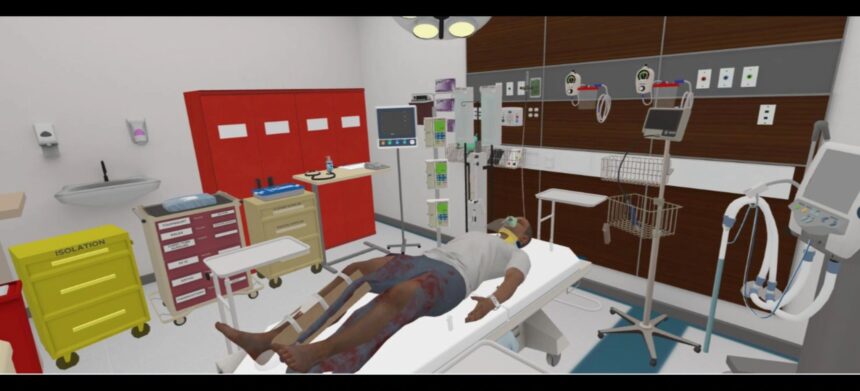
In a cutting‑edge Advanced Trauma Life Support (ATLS) scenario delivered via the SimX VR platform, Dr. Himanshu M. of Laerdal Medical India is training learners to manage a high‑stakes motor vehicle trauma case. Using the ABCDE approach—Airway, Breathing, Circulation, Disability, Exposure—participants must stabilize the patient in real time while navigating evolving instability.
What makes this experience transformative is not just the clinical rehearsal, but the team‑based immersion. Learners are thrust into a dynamic environment where communication, leadership, and role assignment are as critical as intubation or hemorrhage control.
Recent trauma simulation research validates this shift. VR environments have been shown to boost learner confidence and decision‑making in applying ATLS principles, while offering a safe space to repeatedly practice interventions. Studies on VR team training further highlight gains in non‑technical skills—communication, coordination, and shared cognition—that often define trauma outcomes.
In scenarios like airway compromise, the difference between chaos and survival lies in whether the team can synchronize under pressure. VR small‑group training enables exactly this: rehearsing team cognition, recalibrating actions, and building shared mental models that translate directly to safer patient care.
Grounded in emerging trauma education literature, immersive team training is no longer just protocol practice—it is experiential competence building. By transforming structured guidelines into lived team experience, VR platforms like SimX are preparing clinicians not just to know what to do, but to do it together when it matters most.