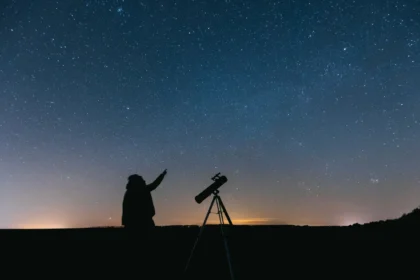




Space and astronomy explore the vast universe beyond Earth, helping us understand everything from planets and stars to mysterious black holes and the origin of the cosmos itself. For thousands of years, humans have looked at the night sky with curiosity. Today, advanced telescopes and space missions allow scientists to uncover the secrets of the universe in ways never before possible.
- What Is Space and Astronomy?
- The Birth of the Universe: The Big Bang
- Stars: The Building Blocks of Galaxies
- Galaxies: Massive Cosmic Cities
- Black Holes: The Most Mysterious Objects
- Planets and Solar Systems
- Dark Matter and Dark Energy
- Modern Space Exploration
- Why Space and Astronomy Matter
- The Future of Space Exploration
- Conclusion

What Is Space and Astronomy?
Space refers to the seemingly infinite area beyond Earth’s atmosphere, where planets, stars, galaxies, and other celestial objects exist. Astronomy is the scientific study of these objects, their movements, and the physical laws that govern them.
Astronomers use powerful telescopes, satellites, and space probes to observe distant objects and understand how the universe works.
The Birth of the Universe: The Big Bang
Scientists believe the universe began about 13.8 billion years ago with a massive event known as the Big Bang. This was not an explosion in space, but an expansion of space itself from a very hot and dense state.
After the Big Bang:
- Energy formed basic particles
- Particles formed atoms like hydrogen and helium
- Gravity pulled atoms together to form stars and galaxies
The universe continues to expand even today.
Stars: The Building Blocks of Galaxies
Stars are massive balls of hot gas, mainly hydrogen and helium, that produce light and heat through nuclear fusion.
Stars go through life cycles:
- Birth in nebulae (clouds of gas and dust)
- Stable phase like our Sun
- Death as white dwarfs, neutron stars, or black holes
Stars are responsible for creating heavier elements like carbon, oxygen, and iron — the elements that make planets and life possible.
Galaxies: Massive Cosmic Cities
Galaxies are huge systems containing billions or trillions of stars, planets, gas, dust, and dark matter.
Types of galaxies include:
- Spiral galaxies (like the Milky Way)
- Elliptical galaxies
- Irregular galaxies
Our solar system exists inside the Milky Way galaxy, which contains over 100 billion stars.
Black Holes: The Most Mysterious Objects
Black holes are regions of space where gravity is so strong that nothing, not even light, can escape.
They form when massive stars collapse at the end of their life cycle.
Key features of black holes:
- Extremely strong gravity
- Event horizon (point of no return)
- Invisible but detectable by their effects on nearby objects
Some black holes are millions or billions of times more massive than the Sun and exist at the center of galaxies.
Planets and Solar Systems
A solar system consists of a star and all objects that orbit it, including planets, moons, asteroids, and comets.
Our solar system includes:
- The Sun
- 8 planets including Earth, Mars, and Jupiter
- Moons, asteroids, and comets
Scientists are discovering thousands of exoplanets orbiting distant stars.
Dark Matter and Dark Energy
Most of the universe is made of invisible substances called dark matter and dark energy.
- Dark matter holds galaxies together with gravity
- Dark energy causes the universe to expand faster
Together, they make up about 95% of the universe.
Modern Space Exploration
Space agencies use advanced technology to explore space.
Important missions include:
- Space telescopes observing distant galaxies
- Mars rovers studying the Martian surface
- Satellites monitoring Earth and space
Modern astronomy helps us understand planetary systems, black holes, and the early universe.
Why Space and Astronomy Matter
Studying space helps humanity:
- Understand our origin
- Discover new planets
- Develop advanced technology
- Search for extraterrestrial life
- Protect Earth from asteroids
Space research also leads to innovations in medicine, communication, and computing.
The Future of Space Exploration
The future includes exciting possibilities such as:
- Human missions to Mars
- Discovering habitable planets
- Understanding dark matter
- Exploring distant galaxies
New technologies and telescopes will continue revealing the universe’s deepest secrets.
Conclusion
Space and astronomy help us understand where we came from and our place in the universe. From black holes and galaxies to the Big Bang, every discovery brings humanity closer to answering fundamental questions about existence. As technology advances, the mysteries of the universe will continue to unfold, inspiring future generations of scientists and explorers.