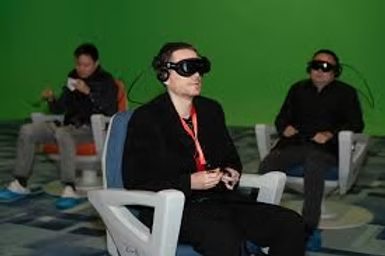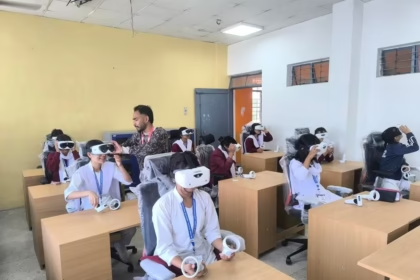




Forget memorizing the steps of digestion from a dog-eared textbook. Students at two schools in the Tambaram Corporation limits can now walk through the human digestive system. They can step inside a beating heart and watch blood move through chambers in real time. For kids in Classes 3 through 12, science class just got a radical upgrade.
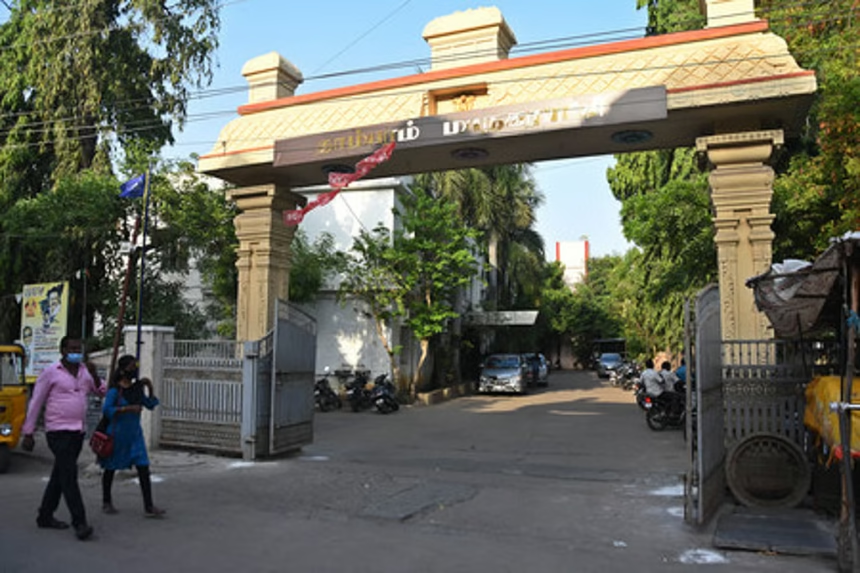
The Tambaram Corporation has commissioned two augmented and virtual reality labs — one at Hasthinapuram and another at Zameen Royapet — at a combined cost of ₹89.37 lakh. Developed by NETCOM and inaugurated by Human Resources Minister D Sarathkumar, the labs represent one of the more ambitious deployments of immersive learning technology in Tamil Nadu’s public school system.
More Than a Gadget Demo
It would be easy to dismiss initiatives like this as expensive novelties — shiny tech dropped into classrooms without real pedagogical purpose. But the curriculum design behind these labs suggests something more deliberate. Interactive modules span a surprisingly broad academic range: Science, Social Science, Physics, Chemistry, Biology, Botany, Zoology, and History are all represented, covering the full stretch from primary to higher secondary education.
That breadth matters. The labs aren’t positioned as extracurricular enrichment for already-engaged students. They’re woven into the core subject areas that students across all grade levels struggle with most — abstract scientific processes, complex historical timelines, and three-dimensional biological structures that flat illustrations simply can’t convey.
Why Immersion Changes the Equation
There’s a growing body of evidence suggesting that experiential learning produces stronger retention than passive instruction. When a student physically navigates the chambers of a heart rather than labeling a diagram, the spatial and emotional engagement of that experience creates memory anchors that rote learning rarely achieves.
VR is particularly well-suited to biological and historical education for exactly this reason. Concepts like blood circulation, cellular respiration, or the layout of an ancient civilization aren’t intuitive from a two-dimensional page. But place a student inside those environments — even a simulated version — and the abstract becomes tangible. The digestive system stops being a list of organs to memorize and becomes a journey with sequence, texture, and cause-and-effect logic.
For students in under-resourced public schools, where lab equipment and field trips may be limited, this kind of simulated experience can be genuinely equalizing.
A Model Worth Watching
Details reported by New Indian Express highlight that this initiative is already drawing attention as a potential template for broader rollout across Tamil Nadu’s municipal school network. The cost per lab — spread across the full student population from Class 3 to 12 — represents a meaningful but not prohibitive investment if outcomes prove measurable.
The real test, of course, will come not at the inauguration but in the months that follow. Are teachers trained to integrate VR sessions meaningfully into lesson plans, or do the headsets gather dust between ministerial visits? Is student engagement translating into improved comprehension scores? Are the modules updated as curriculum standards evolve?
These are the questions that separate a genuine educational initiative from a well-photographed press opportunity.
The Bigger Picture
India’s public education system has long struggled with the tension between scale and quality — serving hundreds of millions of students while delivering instruction that genuinely prepares them for a technology-driven economy. Initiatives like the Tambaram AR/VR labs don’t solve that tension, but they do point toward one part of the answer.
Immersive technology, thoughtfully deployed, can give students in government schools access to learning experiences that were previously confined to private institutions or university research settings. That’s not a small thing.
If the Hasthinapuram and Zameen Royapet labs deliver on their promise, Tamil Nadu may have a compelling case study on its hands — one that other municipal bodies and state governments will be watching closely.