



Onboarding thousands of warehouse workers across dozens of countries is less a training problem and more a logistics problem — which is perhaps why DHL, one of the world’s largest logistics operators, is solving it with the same precision it applies to its supply chains.
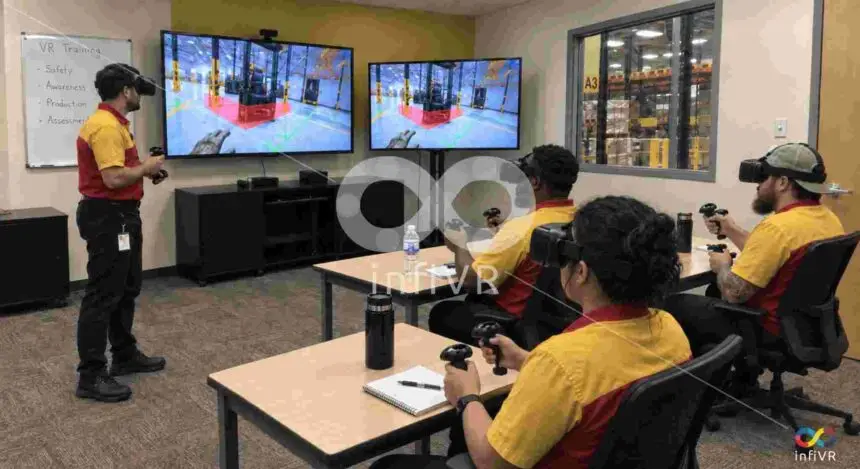
In partnership with immersive tech firm InfiVR, DHL has deployed an AI-powered metaverse platform that places new hires inside high-fidelity digital twins of actual DHL warehouse facilities before they ever set foot on a real floor. The collaboration, detailed on InfiVR’s blog, signals a broader shift in how enterprise-scale companies are rethinking the economics and effectiveness of human onboarding.
The Problem With Traditional Warehouse Training
At DHL’s scale, the math on conventional onboarding is brutal. Classroom instruction doesn’t replicate the sensory chaos of a live warehouse. Training quality varies wildly between sites and regions. And every time a new cohort rolls through, the costs compound. For a company onboarding thousands of workers annually, inconsistency isn’t just inefficient — it’s a safety and productivity liability.
Traditional programs struggled with four specific gaps:
- Inability to simulate reality — static training can’t replicate real equipment, spatial layouts, or time pressure
- Site-to-site inconsistency — different trainers, different standards, different outcomes
- High repetition costs — every new cohort requires the same resource-intensive process
- Uneven global experiences — workers in different regions receive materially different preparation
Where the AI Layer Changes Everything
The InfiVR platform doesn’t just drop workers into a virtual warehouse and walk away. An embedded AI system tracks every action, decision, and hesitation in real-time — building a performance profile that adapts training dynamically and, critically, determines when a worker is genuinely ready for floor deployment.
That last point is significant. Rather than using calendar time or completion checkboxes as proxies for readiness, the system uses behavioral data. It’s a fundamentally different philosophy: readiness as a measurable output, not an assumed outcome.
Why This Model Scales
Digital twins allow DHL to replicate any facility virtually, meaning a worker in Malaysia and one in Germany can train in environments tuned to their actual workplace — with the same standardized AI evaluation underneath. The cost curve also inverts over time: infrastructure built once serves every future cohort.
For global logistics and beyond, this isn’t a novelty deployment. It’s a template for what enterprise-scale immersive onboarding looks like when the technology finally catches up to the problem.