



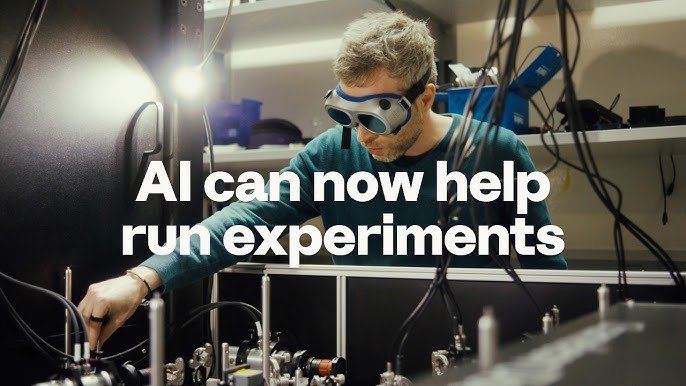
Artificial intelligence has already conquered the inbox, the spreadsheet, and the code editor. Now Anthropic wants it running the microscope, the liquid handler, and the robotic arm — simultaneously, autonomously, and safely. The company has unveiled the Model Hardware Standard (MHS), a shared specification designed to let AI agents operate physical laboratory and manufacturing equipment without the bespoke engineering work that has historically made such integrations painfully slow.
Developed in close collaboration with the HHMI Janelia Research Campus, one of the world’s premier biological research institutions, MHS represents something genuinely novel: a hardware-agnostic protocol that treats physical devices the way the web treats browsers — with a common language underneath, regardless of what’s on top.
The Integration Problem Nobody Talks About
For anyone who has watched a biotech startup burn months trying to get a pipetting robot to talk to a custom software stack, MHS arrives as a kind of confession that the industry has been doing this wrong. Every new instrument, every new AI model, every new research environment has required custom drivers, bespoke middleware, and painful negotiation between hardware vendors and software teams. The result is that the promise of autonomous, AI-orchestrated experiments has remained largely theoretical — not because the AI wasn’t capable, but because the plumbing wasn’t there.
MHS attacks this directly. According to Anthropic’s research preview, integration time for lab and manufacturing facilities drops from weeks or months down to hours or minutes. That’s not a marginal improvement — it’s a fundamental change in what’s feasible for a research team working on a deadline or a manufacturing floor trying to adapt quickly to new processes.
How It Actually Works
The standard is deliberately simple, which is part of the point. MHS uses a standardized driver built around basic commands — think ‘read’ and ‘write’ — that any device with a programmable interface can expose. The elegance here is in the abstraction: an AI agent doesn’t need to know whether it’s talking to a fluorescence microscope or a robotic sample handler. It speaks MHS, the driver translates, and the device responds.
Crucially, the specification is model-agnostic. This isn’t a Claude-only play. Any AI model capable of interfacing with the standard can potentially operate compliant hardware, which broadens adoption incentives significantly and reduces the risk of the spec becoming a proprietary dead end. Anthropic appears to be betting that a rising tide lifts all boats here — if MHS becomes the default, the whole ecosystem, including Claude, benefits.
Why Janelia, and Why Now
The choice of HHMI Janelia as a co-development partner is telling. Janelia is known for tackling problems that are too hard, too slow, or too resource-intensive for conventional academic labs — it’s an institution built around scientific infrastructure. Bringing them in to shape MHS suggests Anthropic isn’t just theorizing about agentic lab work; they’re stress-testing it against real experimental workflows in one of the most demanding research environments on the planet.
The timing also reflects a broader shift in how the AI industry is thinking about physical-world applications. As large language models mature and agentic frameworks become more reliable, the bottleneck in scientific automation is increasingly the interface between digital intelligence and physical instruments — exactly what MHS is designed to dissolve.
The Bigger Picture
If MHS gains traction, the downstream effects could be substantial. Laboratories that currently require dedicated automation engineers to maintain hardware integrations could redeploy that expertise. Research pipelines that run experiments sequentially because parallel orchestration is too complex could be redesigned from scratch. Manufacturing floors could adapt faster to process changes without the integration tax that currently slows every transition.
None of this is guaranteed — standards live and die by adoption, and the lab equipment market is notoriously fragmented. But Anthropic has made a smart opening move by keeping MHS open, model-agnostic, and grounded in real-world research collaboration rather than releasing it as a purely theoretical specification.
The lab of the future might not need a technician to flip every switch. It might just need a driver that speaks MHS.