



Forget focus groups. India’s railway stations — some of the busiest transit hubs on the planet — are being converted into live product testing arenas, and brands are paying attention.
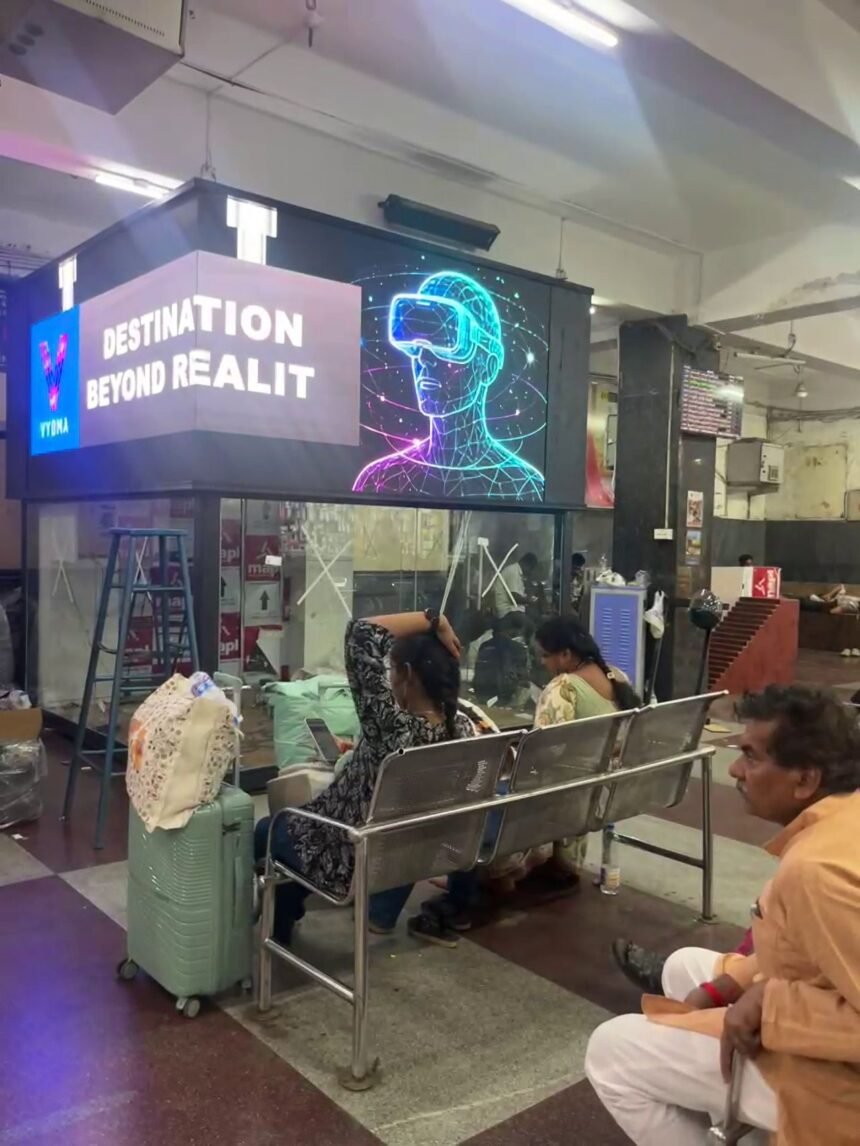
A partnership between Vyoma Media and VR booth operators is placing immersive experience stations inside major Indian railway stations, turning ordinary commute time into something far more commercially valuable. The installations are currently live at four locations — Vijayawada, Visakhapatnam, Mumbai, and Panipat — with eight additional stations already in the pipeline.
The Scale Problem, Solved
Traditional market research has always wrestled with the same fundamental constraint: getting a truly diverse, representative sample costs time and money. Brands typically run separate regional campaigns to test across demographics, layering on complexity and budget just to answer basic questions about how a product lands with different audiences.
Railway stations flip that model entirely. India’s major rail hubs collectively see around 23 million people pass through daily — a cross-section of income levels, age groups, languages, and geographies that no controlled research environment could replicate. A VR booth positioned on a busy platform becomes a passive recruitment engine, drawing in users who are already waiting and already open to distraction.
Commuter Downtime as Market Intelligence
What makes this particularly compelling isn’t just the foot traffic — it’s the context. Commuters exist in a specific psychological state: time to fill, low pressure, mildly open to novelty. That’s a meaningfully different headspace than someone approached in a mall or invited to a product demo. The data captured from voluntary engagement in that environment may carry more authentic signal than traditional testing setups.
For brands, the proposition is straightforward: deploy a single VR experience across multiple stations and gather simultaneous cross-demographic feedback without orchestrating separate campaigns. The geographic spread of the current four stations alone — spanning Andhra Pradesh, Maharashtra, and Haryana — gives brands meaningful regional contrast in a single rollout.
A New Advertising Layer Emerges
This isn’t just about research. As the booth network scales toward a dozen stations, it starts to resemble a media channel with built-in interactivity. Brands aren’t just showing ads — they’re collecting behavioral data on how people physically interact with virtual products.
India’s transit infrastructure, long viewed as a logistics challenge, is quietly becoming one of the most interesting experiential marketing canvases in the world.