



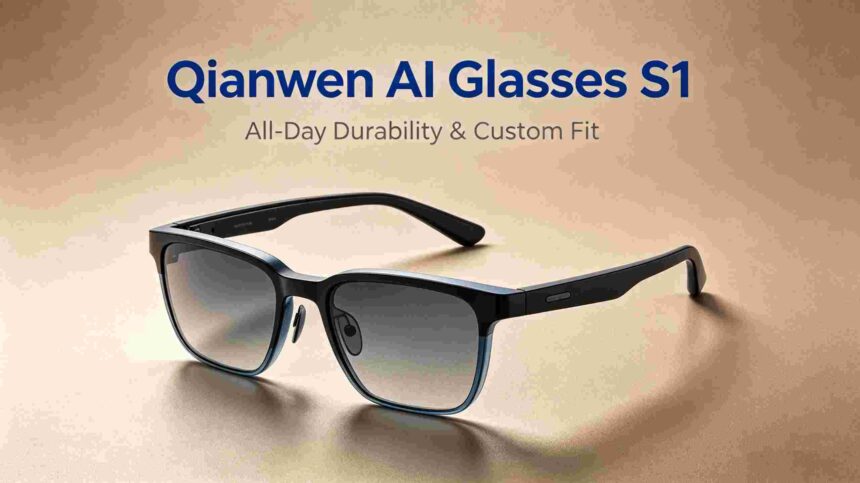
For years, smart glasses have existed in a kind of technological purgatory — impressive in demos, awkward in practice, and perpetually one killer feature away from mainstream relevance. Alibaba may have just found that feature, or rather, a bundle of them.
A major software update to Alibaba’s Qianwen AI-powered glasses has quietly turned the wearable into something far more compelling than a heads-up notification display. The update integrates a suite of practical, everyday services — ride-hailing, instant delivery, and shared bike rentals — directly into the glasses experience, controlled entirely by voice. No pulling out your phone. No fumbling with an app. Just speak, and the city responds.
The End of the Phone-in-Hand Commute?
The centerpiece of the update is the integration of Amap Ride-Hailing, Alibaba’s dominant Chinese mapping and transportation platform. Users can now hail a car, confirm pickup details, and complete payment entirely through voice commands and on-glass interactions. It’s a workflow that previously required unlocking a phone, navigating an app, and tapping through several confirmation screens — now compressed into a hands-free conversation.
That frictionless loop extends to food and essentials as well. An instant delivery feature allows wearers to order items through voice, tapping into the kind of on-demand infrastructure that Chinese consumers already rely on heavily. The glasses become less of a gadget and more of a persistent, ambient interface to the services people use every day.
For micro-mobility, the update adds scan-to-ride support for Hello Bike and Xiaoliu E-bike services. Rather than opening a separate app to scan a QR code with your phone camera, the glasses handle the scan directly — a small friction reduction that, in the context of a rushed morning commute, actually matters.
Cross-Device Intelligence Changes the Equation
Perhaps the most technically interesting element of the update is cross-device collaboration. When an order is placed on a paired smartphone, the glasses sync automatically and deliver real-time status updates through voice. This means Qianwen glasses aren’t competing with your phone so much as extending it — acting as a persistent audio layer that surfaces what’s relevant without requiring you to check a screen.
This design philosophy is smart. It lowers the barrier to adoption by not demanding that users abandon their smartphones entirely. Instead, the glasses slot into existing habits, gradually shifting the center of gravity away from the handheld screen and toward ambient, voice-driven awareness.
Why This Matters Beyond China
Context is everything here. China’s app ecosystem is uniquely suited to this kind of integration — Amap, food delivery platforms, and shared bike networks are deeply embedded in urban daily life in ways that have no direct Western equivalent. Alibaba is building on infrastructure that already works, which gives Qianwen glasses a practical foundation that, say, early Google Glass never had.
But the broader signal is global. The question of what replaces the smartphone — or at least supplements it — has been open for a decade. Smartwatches nibbled at the edges. Earbuds added audio intelligence. Now AI glasses are making a more serious bid, not by reinventing behavior, but by embedding themselves into routines people already have.
The combination of always-on voice AI, real-world service integration, and cross-device continuity is a meaningful step toward wearables that earn their place on your face rather than just occupying it.
Alibaba isn’t the only company pursuing this space — Meta’s Ray-Ban glasses have shown genuine consumer traction with a similar ambient intelligence approach — but this update pushes the category further into practical utility territory than most competitors have managed.
Smart glasses are no longer asking you to change your life around them. They’re starting to fit into it. That’s when adoption actually happens.