



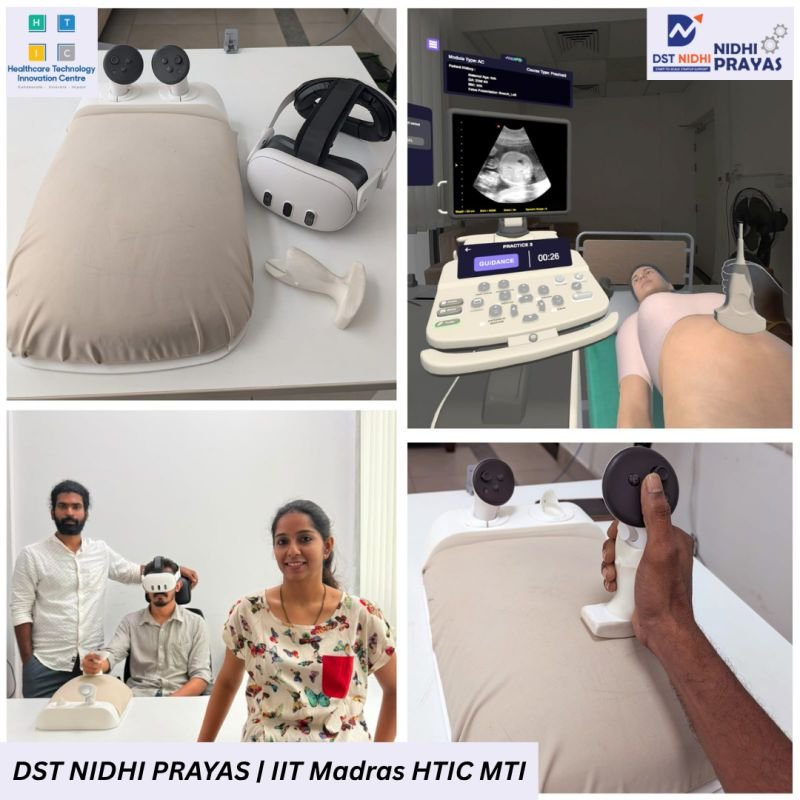
A three-person medical simulation team has successfully completed a government-funded project to build a mixed reality platform for obstetric ultrasound training — a development that could meaningfully shift how healthcare professionals in India acquire one of maternal care’s most essential diagnostic skills.
ManojKumar Lakshmanan, Aparna P, and Shyam Ayyasamy completed the project under the DST NIDHI PRAYAS program, an initiative run by the Department of Science & Technology, Government of India, designed to support early-stage innovators in translating ideas into working prototypes. The work was carried out at the IITM HTIC MedTech Incubator, IIT Madras’s dedicated health technology innovation hub.
The Training Gap in Obstetric Ultrasound
Ultrasound scanning during pregnancy is a nuanced, hands-on skill that takes considerable practice to master. Traditionally, trainees develop proficiency by practicing on real patients — a method that raises concerns around patient comfort, consent, and variability in learning conditions. Access to high-quality, standardized training is especially uneven across India’s healthcare system, where rural and under-resourced facilities often struggle to provide adequate clinical exposure.
This is precisely the gap the team’s Mixed Reality Simulation Platform targets. By overlaying digital ultrasound environments onto a physical training scenario, the platform allows clinicians and students to practice probe placement, image interpretation, and anatomical navigation in an immersive, repeatable, and risk-free setting.
Why Mixed Reality Has an Edge
Unlike purely virtual reality simulations, mixed reality preserves physical interaction — users handle real or near-real instruments while digital imaging data responds dynamically. For ultrasound training, this distinction matters. The muscle memory of probe handling, the pressure applied, and the angle adjustments are all tactile elements that pure screen-based simulation struggles to replicate.
Completing the PRAYAS phase means the prototype has cleared a critical proof-of-concept milestone. The NIDHI PRAYAS grant is explicitly structured to get innovations to a demonstrable stage, making this completion a signal that the platform is ready for the next phase — likely validation studies, clinical partnerships, or scaling discussions.
A Broader Signal for MedTech XR in India
The project is a small but telling indicator of a growing appetite within India’s government-backed innovation ecosystem for immersive technology in healthcare education. As XR hardware becomes more accessible and clinical institutions increasingly open to simulation-based training, platforms like this one are well-positioned to move from incubators to operating rooms.