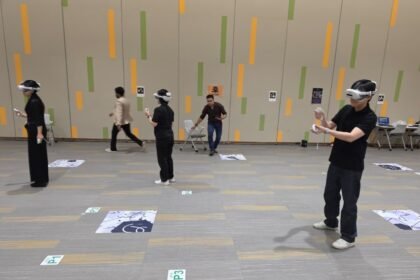




On July 24, 2026, a classroom in Goa quietly crossed a threshold that most Indian schools haven’t reached yet. DesignXR inaugurated the state’s first Integrated VR Science Lab, turning a conventional learning space into an environment where students don’t just read about molecular structures or planetary orbits — they step inside them.
The lab was inaugurated by former Delhi Chief Minister Atishi and Benaulim MLA Capt. Venzy Viegas, lending the event political weight that suggests this isn’t just a one-school experiment. It’s a signal that immersive education technology is beginning to earn serious institutional credibility in India.
Beyond the Textbook Wall
Students in Classes 6 through 10 now have access to interactive 3D models, curriculum-aligned VR experiences, and hands-on visualizations that address one of the most persistent problems in science education: abstraction. Concepts like cell division, electromagnetic fields, or chemical bonding are notoriously difficult to grasp from diagrams alone. VR dissolves that barrier by making the invisible tangible.
This matters more than it might appear. Research consistently shows that immersive learning environments improve both retention and engagement — particularly for students who struggle with traditional rote instruction. For a country still working to close learning outcome gaps post-pandemic, tools like this aren’t just innovative. They’re remedial in the best possible sense.
DesignXR’s Broader Bet
DesignXR is positioning this Goa installation as a proof-of-concept for wider adoption. The company’s pitch is straightforward: immersive technology doesn’t replace teachers, it amplifies them. When a student can rotate a 3D human heart or walk through a virtual ecosystem, the teacher’s role shifts from transmitter to guide — a dynamic that better prepares students for collaborative, inquiry-based work environments.
The initiative also arrives at a moment when India’s National Education Policy is actively encouraging experiential and technology-integrated learning. Schools that move early on VR infrastructure will likely have a competitive edge in both student outcomes and institutional reputation.
What Comes Next
The real test won’t be the inauguration — it’ll be the classroom hours that follow. VR labs have stumbled before when novelty fades and teacher training doesn’t keep pace with the hardware. If DesignXR has built for sustained curriculum integration rather than spectacle, Goa’s first VR science lab could become a blueprint. If not, it risks becoming another underused piece of expensive equipment gathering dust beside the projector.
Either way, the experiment is worth watching.