



One of the most stubborn engineering failures in augmented reality has never made headlines the way display resolution or field-of-view debates have — but it may be the single biggest reason AR glasses aren’t on more faces today. The problem is brightness, and more specifically, the catastrophic light loss that comes with building true occlusion into optical see-through displays.
Now a research team spanning Shanghai Jiao Tong University, Graz University of Technology, Nara Institute of Science and Technology, and Zhejiang University has published a solution in IEEE Transactions on Visualization and Computer Graphics that could fundamentally change the math.
Why Occlusion Kills the Light
Real occlusion — where virtual objects can actually block real-world ones — is considered essential for believable AR. Without it, a holographic coffee cup sitting on a real table looks like a ghost floating in front of it. But achieving occlusion in optical see-through systems requires polarization processing that strips away enormous amounts of ambient light. Current headsets with occlusion capability sit below 20% theoretical maximum transmittance. Actual built prototypes fare even worse, falling below 7%. In practical terms, that means the world through your AR headset looks like you’re wearing very dark sunglasses — indoors.
This isn’t a software problem. It’s physics. And until now, the workarounds have mostly involved accepting the tradeoff or abandoning true occlusion entirely.
Splitting the Light, Not Losing It
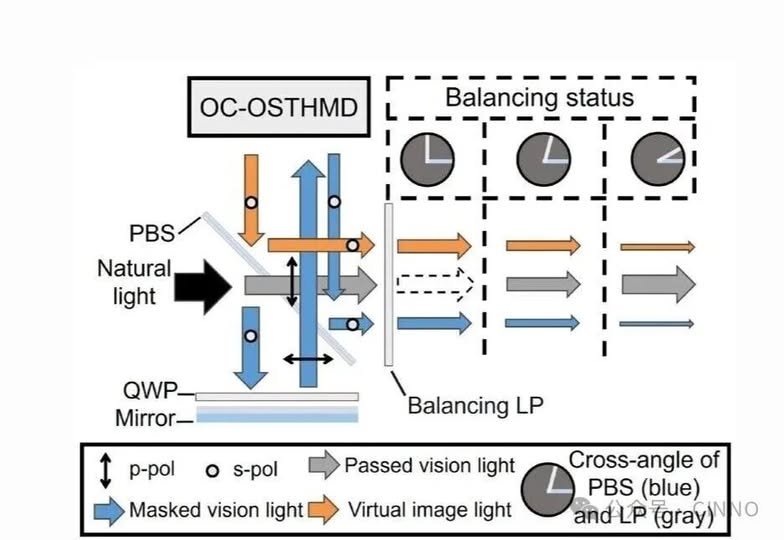
The new approach introduces a rotatable linear polarizer that splits incoming natural light into two separate paths. One path routes through the occlusion optics responsible for rendering virtual imagery. The other bypasses the attenuating elements entirely, preserving full ambient brightness. The ratio between these two paths isn’t fixed — it’s dynamically adjusted in real time using eye tracking and scene-aware visual analysis informed by perceptual models that account for lighting conditions moment to moment.
The elegance here is in what the system doesn’t do: it doesn’t try to brute-force more light through a lossy pipeline. It routes light around the bottleneck when perception allows it.
A Critical Unlock for Consumer and Industrial AR
The implications extend well beyond labs. Outdoor AR use cases — construction, logistics, field service, navigation — have been effectively off the table for occlusion-capable headsets because sunlight exposure makes sub-7% transmittance genuinely dangerous and disorienting. This architecture addresses that constraint directly.
Consumer AR has been caught in a catch-22: users want immersive occlusion, but the brightness penalty makes the experience worse overall. A perceptually-driven balancing system that intelligently trades off occlusion fidelity for usable ambient light could finally break that deadlock.
The research has been published but commercialization timelines remain unspecified. Still, with the findings landing in one of the field’s most respected peer-reviewed venues, the pressure on headset manufacturers to incorporate this kind of optical architecture just increased considerably.