



By using this site, you agree to the Privacy Policy and Terms of Use.
Accept
1CW - Ones Changing the World Logo 1CW - Ones Changing the World Logo
  • My Saved
  • My Bookmarks
  • Events
  • About Us
    • Contact
  • Advertise
Reading: Scientists Just Ran a Living Cell on a Computer. Here’s Why It Matters
Share
Sign In
Notification
  • Future Tech
    • Artificial Intelligence
    • XR, VR, AR – XROM
    • Robotics & Automation
    • Blockchain
    • Quantum & Nanotechnology
    • Automotive
    Future Tech
    Future Tech explores breakthrough technologies shaping tomorrow’s world. From artificial intelligence to next-generation computing and immersive experiences, this section covers innovations that are transforming industries,…
    Show More
    Top News
    RayNeo × Warner Bros. Major Collaboration! RayNeo Air 4 Pro Batman Limited Edition Launches at 1,899 CNY
    March 31, 2026
    China Issued First National ID Card for AI Virtual Idol
    February 25, 2026
    Virtual Reality Theatre Set to launch at National Science Centre, Delhi
    March 7, 2026
    Latest News
    Alibaba’s AI Glasses Want to Replace Your Smartphone — Starting With Your Commute
    July 13, 2026
    Solos Bets on Two Extremes: A Featherlight Camera-Free AI Glass and a Full-Featured Global Flagship
    July 13, 2026
    Newline’s NewGlasses Want to Be the AI Co-Pilot Sitting on Your Face
    July 13, 2026
    Alipay Opens AI Platform to Merchants, Turning Mini-Programs Into Multi-Device Services
    July 13, 2026
  • Science & Discovery
    • Life Sciences & Biotechnology
    • Health & Medicine
    • Earth & Environment
    • Space & Astronomy
    Science & Discovery
    Science & Discovery brings you the latest breakthroughs from research labs, universities, and space agencies. This section highlights discoveries expanding our understanding of life, health,…
    Show More
    Top News
    Exploring Space & Astronomy: How Modern Telescopes Are Revealing the Secrets of the Universe
    February 23, 2026
    Ai Med Agent
    The AI That Wears Your Eyes — and Walks Into the OR
    April 1, 2026
    How NASA and Modern Science Are Unlocking the Secrets of the Universe
    February 21, 2026
    Latest News
    From Brain Waves to Words: Brain2Qwerty Offers a New Path to Communication Without Surgery
    June 30, 2026
    A new generation of cell therapy developed by the EU-funded…
    June 30, 2026
    The Science of Forest Bathing: How Trees Hack Your Stress and Supercharge Immunity
    June 20, 2026
    Breaking Ground in Neurotechnology: Man Regains Ability to Speak After Years of Silence
    June 17, 2026
  • Innovation & Industry
    • Startups & Entrepreneurship
    • Corporate Tech & Semiconductors
    • Telecom & Energy Tech
    • Policy & Economy
    Innovation & Industry
    Innovation & Industry focuses on business transformation, emerging companies, and the technologies driving economic growth worldwide.
    Show More
    Top News
    5G Rollout Accelerates Across Asia-Pacific and North America in 2026
    February 23, 2026
    AI-Driven Startups Raise Record Funding in 2026 Across Global Markets
    February 23, 2026
    Telecom Companies Explore Satellite Internet Expansion for Remote Areas
    February 23, 2026
    Latest News
    NVIDIA ASPIRE: Agentic/Skills Discovery for Robotics
    July 1, 2026
    From Brain Waves to Words: Brain2Qwerty Offers a New Path to Communication Without Surgery
    June 30, 2026
    Lio raises $30M from Andreessen Horowitz and others to automate enterprise procurement
    March 7, 2026
    Economic Policies in Emerging Markets Fuel Startup Growth and Innovation
    February 23, 2026
  • Regions
    • India
    • North America
    • Europe
    • Middle East & Africa
    • China
    • Latin America
    • Asia-Pacific
  • 1CW Podcast
  • XROM Podcast
Reading: Scientists Just Ran a Living Cell on a Computer. Here’s Why It Matters
Share
Font ResizerAa
1CW - Ones Changing the World1CW - Ones Changing the World
  • My Saved
  • Login
  • 1CW Podcast
  • XROM Podcast
Search
  • Future Tech
    • Artificial Intelligence
    • Blockchain
    • XR, VR, AR – XROM
    • Quantum & Nanotechnology
    • Robotics & Automation
    • Automotive
  • Science & Discovery
    • Earth & Environment
    • Health & Medicine
    • Life Sciences & Biotechnology
    • Space & Astronomy
  • Innovation & Industry
    • Corporate Tech & Semiconductors
    • Policy & Economy
    • Startups & Entrepreneurship
    • Telecom & Energy Tech
  • Regions
    • India
    • North America
    • Europe
    • Asia-Pacific
    • China
    • Middle East & Africa
    • Latin America
Have an existing account? Sign In
Follow US
  • About Us
  • Contact
  • Adverstise
  • Events
  • Join Us
  • Member Login
  • My Bookmarks
  • Terms
  • Privacy
1CW - Ones Changing the World > Blog > Future Tech > Artificial Intelligence > Scientists Just Ran a Living Cell on a Computer. Here’s Why It Matters
Artificial IntelligenceHealth & MedicineLife Sciences & BiotechnologyScience & Discovery

Scientists Just Ran a Living Cell on a Computer. Here’s Why It Matters

Eddie Avil
Last updated: March 14, 2026 5:55 AM
Eddie Avil - Co-Founder
Share
SHARE
Virtual Cell
Virtual Cell Simulation

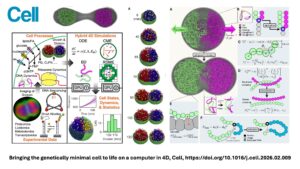
Imagine building a working replica of a living cell inside a computer — every gene switched on at the right moment, every protein assembled in the right place, the whole thing growing and eventually splitting in two, exactly as it would in nature. Scientists have now done exactly that.

A team led by chemist Zan Luthey-Schulten at the University of Illinois published the first ever 4D simulation of a complete cell lifecycle in the journal Cell this month. The cell is tiny, simple, and artificial — but what it represents is historic.

The Cell They Chose — And Why

The subject of the simulation is JCVI-Syn3A, a synthetic bacterium created by the J. Craig Venter Institute. It has just 493 genes — roughly one-fortieth the complexity of a human cell — making it the simplest known self-replicating organism. It was the only realistic starting point for a project of this ambition.

The simulation tracked its full 105-minute cell cycle: DNA replicating itself, ribosomes building proteins, metabolism converting nutrients into energy, the outer membrane expanding, and finally the cell physically dividing into two. All of these processes ran simultaneously, interacting with each other in real time, in three-dimensional space.

The Numbers Are Staggering

To simulate just 105 minutes of cellular life required 4 to 6 days of continuous GPU computing — the computer ran about 80 times slower than the actual cell. Simulating 50 cells cost 15,000 GPU hours, the electricity equivalent of running an average home for roughly 7 months.

Two dedicated GPUs were needed: one solely for simulating DNA replication (so computationally expensive it was doubling total runtime), and a second for everything else.

Now consider: Syn3A has 493 genes. A human cell has approximately 20,000. The complexity does not scale linearly — it scales exponentially. Simulating a human cell at this resolution is still a very distant goal. But for the first time, it’s a goal we know is reachable.

Why Simulate a Cell at All? –Biology’s biggest problem is that cells are too small and too fast to watch in real time. We can freeze them, stain them, and take snapshots — but seeing the full movie of life happening at the molecular level has never been possible. A virtual cell is that movie.

The practical stakes are enormous. About 90% of drugs that enter clinical trials fail — either because they don’t work or because of unexpected side effects on cellular machinery. A virtual cell lets researchers test thousands of drug candidates digitally, before a single molecule touches a living organism. That alone could transform pharmaceutical development.

Beyond drug discovery: virtual cells could reveal the molecular roots of cancer, explain why cells age, model how genetic mutations cause disease, and help predict how a new pathogen interacts with human cells before it becomes a pandemic.

The Bigger Race: Who Else Is Building Virtual Cells –The UIUC simulation is a landmark — but it sits within a global sprint toward the same goal.

The Arc Institute launched the first Virtual Cell Challenge in 2025, drawing over 5,000 participants from 114 countries and 1,200+ competing teams. The challenge asked a pointed question: can an AI model predict how a cell responds to having a specific gene silenced — accurately enough to replace a real lab experiment? The winning team, from BioMap Research in China, built a hybrid AI-plus-statistics model.

The honest conclusion from the challenge: pure AI is not yet reliably beating statistical baselines. There’s more work to do.

The Chan Zuckerberg Initiative (CZI), the philanthropy of Mark Zuckerberg and Priscilla Chan, has made virtual cells its central scientific mission. CZI has catalogued data from nearly 100 million cells through its open CELL by GENE platform and partnered with NVIDIA to scale that to billions of cellular observations. In 2025, it launched rBio, described as the first AI reasoning model trained on virtual cell simulations. CZI’s Biohub network is also building a Virtual Immune System — a model of human immune response that could reshape how we design vaccines and treat autoimmune disease.

The J. Craig Venter Institute — the creators of Syn3A itself — remains the essential experimental foundation. Over 50 laboratories worldwide now use Syn3A as a research organism. You cannot simulate what you do not understand, and JCVI spent decades building that understanding from scratch.

What’s Still Missing –Scientific honesty matters here. The simulation, as groundbreaking as it is, has real limitations. Some fine-grained gene co-transcription events were not modeled. Around 92 of Syn3A’s 493 genes still have unknown functions — meaning the simulation is partially running on educated guesses. And the gap between a 493-gene bacterium and a 20,000-gene human cell is vast.

Tissue-level biology — how millions of cells communicate, coordinate, and organize into organs — adds another layer of complexity entirely. We are years, possibly decades, from simulating that.

The Bottom Line –A team of scientists has simulated a living cell, completely, in 3D, for the first time. It required a supercomputer, months of planning, and years of foundational research. And it only worked because they chose the simplest cell on Earth.

But the proof of concept is now real. Biology has its AlphaFold moment — the point where computation caught up to complexity. From here, the question is not whether we can simulate a human cell. It’s how long it will take.

The answer to that question will shape the future of medicine.

Solos Bets on Two Extremes: A Featherlight Camera-Free AI Glass and a Full-Featured Global Flagship
Harnessing AI + AR: India’s Digital Revolution to Preserve Cultural Heritage
Ray-Ban Meta (Gen 2) Launch in India: 2X Battery life, Better Video Capture
Li Auto Officially Announces Livis AI Glasses, Set to Launch on December 3rd
Autonomous Vehicles Explained: How Self-Driving Cars Are Changing Transportation

Sign Up For Daily Newsletter

Be keep up! Get the latest breaking news delivered straight to your inbox.
By signing up, you agree to our Terms of Use and acknowledge the data practices in our Privacy Policy. You may unsubscribe at any time.
Share This Article
Facebook Copy Link Print
Share
Eddie Avil
ByEddie Avil
Co-Founder
Follow:
An XR+Deeptech Evangelist, Podcaster & builder focused on transforming bold ideas into scalable impact. With a sharp eye for innovation and execution, he brings strategic clarity and operational depth to every initiative. His work centers on turning ambition into tangible outcomes that shape industries and communities.
Previous Article Disney+ is rolling out its TikTok-like ‘Verts’ short-form video feed
Next Article IICT Now Operational in Mumbai: Immersive Studios, 136 Students & 18 AVGC-XR Courses Shaping India’s Creative Future
Leave a Comment

Leave a Reply Cancel reply

Your email address will not be published. Required fields are marked *

Stay Connected

248.1KLike
69.1KFollow
134KPin
54.3KFollow

 banner							
 banner
Create an Amazing Newspaper
Discover thousands of options, easy to customize layouts, one-click to import demo and much more.
Learn More

Latest News

Alibaba’s AI Glasses Want to Replace Your Smartphone — Starting With Your Commute
Artificial Intelligence Asia-Pacific China XR, VR, AR – XROM
Newline’s NewGlasses Want to Be the AI Co-Pilot Sitting on Your Face
Artificial Intelligence Asia-Pacific China XR, VR, AR – XROM
Alipay Opens AI Platform to Merchants, Turning Mini-Programs Into Multi-Device Services
Artificial Intelligence Asia-Pacific China
Uttar Pradesh Is Putting AR-VR Lounges on Top of Food Trucks — and It Might Just Work
XR, VR, AR – XROM

Regions

  • Artificial Intelligence
  • XR, VR, AR – XROM
  • Blockchain
  • Quantum & Nanotechnology
  • Robotics & Automation
  • Automotive

You Might also Like

What the Future of Work Truly Looks Like in the Era of Generative AI

Eddie Avil
Eddie Avil
6 Min Read
Artificial Intelligence

51 AVGC‑XR Startups Unveil AI‑Powered Creativity at WAVES Creators’ Corner, India AI Impact Expo 2026

Sanan Goyal
2 Min Read
Artificial Intelligence

When AI Gets Eyes: How Gemini and Qira Redefined Reality at CES 2026

Sanan Goyal
5 Min Read
//

We influence 20 million users and is the number one business and technology news network on the planet

Connect

  • About Us
  • Contact
  • Adverstise
  • Events
  • Join Us
  • Member Login
  • My Bookmarks
  • Terms
  • Privacy

Future Tech

  • Artificial Intelligence
  • XR, VR, AR – XROM
  • Blockchain
  • Quantum & Nanotechnology
  • Robotics & Automation
  • Automotive

Science & Discovery

  • Life Sciences & Biotechnology
  • Earth & Environment
  • Health & Medicine
  • Space & Astronomy

Innovation & Industry

  • Startups & Entrepreneurship
  • Policy & Economy
  • Corporate Tech & Semiconductors
  • Telecom & Energy Tech

Regions

  • India
  • North America
  • Europe
  • Asia-Pacific
  • China
  • Latin America
  • Middle East & Africa

Always Stay Up to Date

Subscribe to our newsletter to get our newest articles instantly!
1CW + XROM logo white 1CW + XROM logo white

Follow US   

© 2026 1CW Media Network. All Rights Reserved.

Join Us!
Subscribe to our newsletter and never miss our latest news, podcasts etc..
Zero spam, Unsubscribe at any time.
Welcome Back!

Sign in to your account

Username or Email Address
Password

Lost your password?

Continue with Google
Not a member? Sign Up