



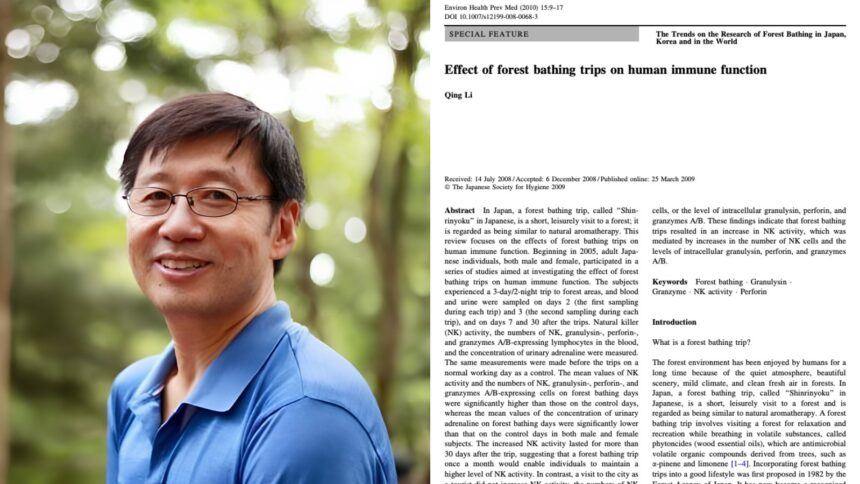
For two decades, a Japanese immunologist named Qing Li has been quietly revolutionizing our understanding of the human body’s response to nature. His groundbreaking research on the effects of forest bathing on stress hormones and immune systems has led to the development of a clinically prescribed therapy in Japan and Korea.
It all began in 1982 when the Japanese Ministry of Agriculture, Forestry and Fisheries coined the term “shinrin-yoku” – slow, mindful walking in a forest. The idea was born out of necessity: Japan was rapidly urbanizing, stress-related illnesses were on the rise, and thousands of square kilometers of unused forest land sat waiting to be explored.
Fast forward to 2005, when Li ran his first proper experiment. Twelve healthy adult men were taken on a three-day, two-night trip to a forest park, where they walked for a few hours each day without any strenuous exercise or breathing exercises. They simply strolled through the trees, breathing in the air and taking in the surroundings.
Li drew blood and urine samples before the trip, on the second day, on the third day, on day seven after returning home, and again on day thirty. The results were nothing short of astonishing. The activity of natural killer cells – a type of immune cell that hunts down cancer cells and virus-infected cells – had jumped by roughly 50 percent during the forest trip.
Moreover, three different anti-cancer proteins produced by those cells – perforin, granzymes, and granulysin – had all risen sharply. And the effect did not disappear when the men went home. The immune boost was still measurable on day seven and remained partially present on day thirty.
Two hours a day in a forest had upgraded the immune system for a full month. Li’s findings were nothing short of remarkable, and they challenged conventional wisdom about the impact of nature on human health.
Interestingly, the Japanese government has been funding Li’s research since 2004, recognizing the potential benefits of his work. Today, shinrin-yoku is an officially prescribed clinical therapy in Japan and Korea, with many hospitals and clinics incorporating forest bathing into their treatment plans.
Li’s work has also shed light on the importance of mindfulness and slow movement in a natural environment. By slowing down and immersing ourselves in nature, we can tap into its restorative powers and boost our immune systems in ways that traditional therapies often cannot.
As Li himself notes, his research has been met with skepticism at times, but the data speaks for itself. “We’ve shown that forest bathing is not just a feel-good activity,” he says. “It’s actually a powerful tool for improving human health.”