



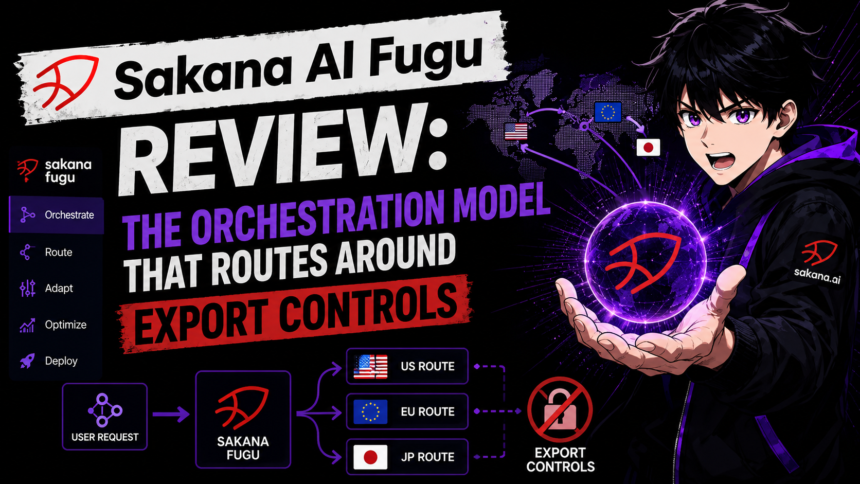
On June 22, 2026, Tokyo-based Sakana AI did something unusual: instead of announcing a bigger model, they announced a smarter coordinator. The company revealed its latest creation, Sakana Fugu, a multi-agent orchestration system that presents itself as a single API, yet internally routes tasks across a pool of the world’s best models dynamically, adaptively, and without hardcoded rules.
Fugu Ultra, its flagship variant, has already made waves by benchmarking shoulder-to-shoulder with Anthropic’s Fable 5 and Mythos Preview – two of the most capable models that became inaccessible to most of the world due to national-security-based export controls on June 12, 2026. Whether this claim holds up in production is a separate question, but the idea of building an orchestration layer that routes around vendor lock-in is precisely what’s needed at this moment.
So, what exactly is Sakana AI Fugu? In simple terms, it’s a multi-agent system that behaves like a foundation model. You send a request to one endpoint – one OpenAI-compatible API call – and Fugu decides internally how to handle it. For straightforward tasks, the response comes directly from Fugu. However, for more complex, multi-step requests, the system triggers the assembly of a coordinated team of expert models: one plans, one executes, one verifies, and one synthesizes.
The result is presented as a single, coherent answer, with none of the coordination complexity ever touching your code. This approach is technically interesting because Fugu itself is a trained language model, not a router built with if/else logic. The orchestration is learned, not hardcoded. Fugu has been trained to understand when to delegate, how agents should communicate, and how to combine their outputs into something reliable.
This is rooted in Sakana AI’s two ICLR 2026 papers: TRINITY (an evolved LLM coordinator) and the Conductor (learning to orchestrate agents in natural language). The academic lineage matters here; this isn’t prompt engineering dressed up as a product. Fugu represents a philosophical departure from existing AI agent frameworks, which require you to build the orchestration layer in your code.
For context, tools like Hugging Face’s Transformers or Google’s TensorFlow Models Hub rely on manual configuration and coding to manage complex tasks. In contrast, Sakana Fugu internalizes this complexity into its model itself, making it a game-changer for developers and researchers alike.
The geopolitical context is also worth noting. On June 12, 2026, Anthropic’s most capable models became subject to national-security-based export controls, effectively limiting access to these powerful tools. Sakana AI Fugu Ultra’s ability to match the performance of these models without being restricted by export controls makes it an attractive solution for organizations looking to maintain their research momentum.
Fugu’s orchestration capabilities have significant implications for various industries, from healthcare and finance to education and entertainment. By routing tasks across a pool of expert models, Sakana AI is enabling developers to build more sophisticated applications that can tackle complex problems in innovative ways.
The future of AI development looks brighter with the emergence of systems like Sakana Fugu. As researchers continue to explore new frontiers in machine learning and natural language processing, it’s essential to recognize the value of orchestration models that learn to coordinate tasks without manual intervention. The potential for innovation is vast, and Sakana AI’s latest creation is poised to play a significant role in shaping this future.