



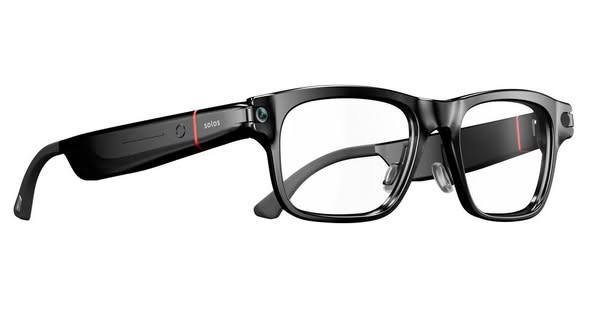
The smart glasses market has spent the last two years chasing one template — a camera-enabled, AI-connected wearable that blurs the line between fashion accessory and surveillance device. Solos is now pushing back on that monoculture with a two-pronged strategy: a stripped-down, camera-free model aimed at weight-conscious users, and a set of privacy tools designed to make camera models more socially acceptable. It’s an unusually self-aware move from a category that has largely ignored the elephant in the room.
The AirGo A6: Less Is More
The AirGo A6 is built around a single, deliberate omission. Without a camera, the frame sheds enough hardware to land at approximately 19 grams without lenses — a figure that puts it among the lightest AI smart glasses currently on the market. That’s not a trivial distinction. Comfort over extended wear is one of the most-cited barriers to smart glasses adoption, and every gram matters when something sits on your face for eight-plus hours.
What the A6 lacks in optics it makes up for in software. The glasses still support Solos’ full AI feature stack, including SolosChat, real-time language translation, and hands-free voice commands — all delivered through open-ear audio that keeps users aware of their surroundings. For commuters, athletes, or professionals who want ambient AI assistance without the social friction of a visible camera, the A6 presents a genuinely compelling pitch.
It also sidesteps a growing cultural and regulatory conversation. In workplaces, gyms, and public spaces, camera-equipped wearables are increasingly scrutinized. The A6 doesn’t ask users to negotiate that discomfort — it removes the variable entirely.
A Privacy Kit That Acknowledges the Problem
For users who do want camera functionality, Solos is introducing a physical privacy kit priced between $39 and $79. The kit pairs ClearView temples — a visual cue that signals transparency — with a clip-on camera cover that physically blocks the lens when not in use. It’s a practical acknowledgment that software-side privacy indicators alone haven’t satisfied critics or skeptical bystanders.
The move is significant because it treats privacy as a hardware problem, not a PR problem. Meta’s Ray-Ban smart glasses, arguably the category’s current market leader, have faced persistent criticism over passive recording concerns. Solos is betting that giving users a tangible, visible way to disable the camera builds the kind of trust that reassures both wearers and the people around them.
AirGo V2 Goes Global
While the A6 courts minimalists, Solos isn’t abandoning the high-end segment. The AirGo V2 — the company’s flagship — is now available globally, starting at $299. It packs a 16-megapixel camera capable of 2K video at 30 frames per second, alongside a battery rated for 10 to 12 hours of use. On paper, those specs are competitive with anything currently shipping in the consumer smart glasses space.
The global rollout matters as much as the hardware. Smart glasses have been largely confined to North American and select European markets, and broader availability signals growing manufacturer confidence in international demand. Solos appears to be positioning itself for the next wave of adoption rather than just the early-adopter niche.
Reading the Room
What makes Solos’ current lineup interesting isn’t any single product — it’s the range. A sub-20-gram no-camera option, a physical privacy attachment, and a globally available full-featured flagship represent three distinct answers to three distinct user objections: weight, privacy concern, and geographic availability.
Smart glasses are no longer a novelty pitch. They’re becoming a product category that has to answer real questions from real consumers. Solos, for now, appears to be one of the few players actually listening to those questions — and building hardware around the answers rather than hoping the questions go away.