



By using this site, you agree to the Privacy Policy and Terms of Use.
Accept
1CW - Ones Changing the World Logo 1CW - Ones Changing the World Logo
  • My Saved
  • My Bookmarks
  • Events
  • About Us
    • Contact
  • Advertise
Reading: The Brightness Problem Killing AR Headsets May Finally Have a Fix
Share
Sign In
Notification
  • Future Tech
    • Artificial Intelligence
    • XR, VR, AR – XROM
    • Robotics & Automation
    • Blockchain
    • Quantum & Nanotechnology
    • Automotive
    Future Tech
    Future Tech explores breakthrough technologies shaping tomorrow’s world. From artificial intelligence to next-generation computing and immersive experiences, this section covers innovations that are transforming industries,…
    Show More
    Top News
    RayNeo × Warner Bros. Major Collaboration! RayNeo Air 4 Pro Batman Limited Edition Launches at 1,899 CNY
    March 31, 2026
    China Issued First National ID Card for AI Virtual Idol
    February 25, 2026
    Virtual Reality Theatre Set to launch at National Science Centre, Delhi
    March 7, 2026
    Latest News
    Moonix Bets on Invisibility: AI Glasses That Listen First, Compute Later
    July 29, 2026
    NVIDIA Bets on Ilya Sutskever’s Safety-First AI Lab as the Race to Superintelligence Heats Up
    July 28, 2026
    Kimi K3 Is the Open-Source AI Model That Shouldn’t Exist Yet
    July 28, 2026
    Train Without Grounding: Parallax Labs Puts Military Aircraft Maintenance Inside a VR Cockpit
    July 24, 2026
  • Science & Discovery
    • Life Sciences & Biotechnology
    • Health & Medicine
    • Earth & Environment
    • Space & Astronomy
    Science & Discovery
    Science & Discovery brings you the latest breakthroughs from research labs, universities, and space agencies. This section highlights discoveries expanding our understanding of life, health,…
    Show More
    Top News
    Exploring Space & Astronomy: How Modern Telescopes Are Revealing the Secrets of the Universe
    February 23, 2026
    Ai Med Agent
    The AI That Wears Your Eyes — and Walks Into the OR
    April 1, 2026
    How NASA and Modern Science Are Unlocking the Secrets of the Universe
    February 21, 2026
    Latest News
    From Brain Waves to Words: Brain2Qwerty Offers a New Path to Communication Without Surgery
    June 30, 2026
    A new generation of cell therapy developed by the EU-funded…
    June 30, 2026
    The Science of Forest Bathing: How Trees Hack Your Stress and Supercharge Immunity
    June 20, 2026
    Breaking Ground in Neurotechnology: Man Regains Ability to Speak After Years of Silence
    June 17, 2026
  • Innovation & Industry
    • Startups & Entrepreneurship
    • Corporate Tech & Semiconductors
    • Telecom & Energy Tech
    • Policy & Economy
    Innovation & Industry
    Innovation & Industry focuses on business transformation, emerging companies, and the technologies driving economic growth worldwide.
    Show More
    Top News
    5G Rollout Accelerates Across Asia-Pacific and North America in 2026
    February 23, 2026
    AI-Driven Startups Raise Record Funding in 2026 Across Global Markets
    February 23, 2026
    Telecom Companies Explore Satellite Internet Expansion for Remote Areas
    February 23, 2026
    Latest News
    EssilorLuxottica, Lynx, and the Battle for AR’s Invisible Stack
    July 18, 2026
    NVIDIA ASPIRE: Agentic/Skills Discovery for Robotics
    July 1, 2026
    From Brain Waves to Words: Brain2Qwerty Offers a New Path to Communication Without Surgery
    June 30, 2026
    Lio raises $30M from Andreessen Horowitz and others to automate enterprise procurement
    March 7, 2026
  • Regions
    • India
    • North America
    • Europe
    • Middle East & Africa
    • China
    • Latin America
    • Asia-Pacific
  • 1CW Podcast
  • XROM Podcast
Reading: The Brightness Problem Killing AR Headsets May Finally Have a Fix
Share
Font ResizerAa
1CW - Ones Changing the World1CW - Ones Changing the World
  • My Saved
  • Login
  • 1CW Podcast
  • XROM Podcast
Search
  • Future Tech
    • Artificial Intelligence
    • Blockchain
    • XR, VR, AR – XROM
    • Quantum & Nanotechnology
    • Robotics & Automation
    • Automotive
  • Science & Discovery
    • Earth & Environment
    • Health & Medicine
    • Life Sciences & Biotechnology
    • Space & Astronomy
  • Innovation & Industry
    • Corporate Tech & Semiconductors
    • Policy & Economy
    • Startups & Entrepreneurship
    • Telecom & Energy Tech
  • Regions
    • India
    • North America
    • Europe
    • Asia-Pacific
    • China
    • Middle East & Africa
    • Latin America
Have an existing account? Sign In
Follow US
  • About Us
  • Contact
  • Adverstise
  • Events
  • Join Us
  • Member Login
  • My Bookmarks
  • Terms
  • Privacy
1CW - Ones Changing the World > Blog > XR, VR, AR – XROM > The Brightness Problem Killing AR Headsets May Finally Have a Fix
XR, VR, AR – XROM

The Brightness Problem Killing AR Headsets May Finally Have a Fix

Eddie Avil
Last updated: July 29, 2026 5:19 AM
Eddie Avil - Co-Founder
Share
SHARE

One of the most stubborn engineering failures in augmented reality has never made headlines the way display resolution or field-of-view debates have — but it may be the single biggest reason AR glasses aren’t on more faces today. The problem is brightness, and more specifically, the catastrophic light loss that comes with building true occlusion into optical see-through displays.

Contents
  • Why Occlusion Kills the Light
  • Splitting the Light, Not Losing It
  • A Critical Unlock for Consumer and Industrial AR

Now a research team spanning Shanghai Jiao Tong University, Graz University of Technology, Nara Institute of Science and Technology, and Zhejiang University has published a solution in IEEE Transactions on Visualization and Computer Graphics that could fundamentally change the math.

Why Occlusion Kills the Light

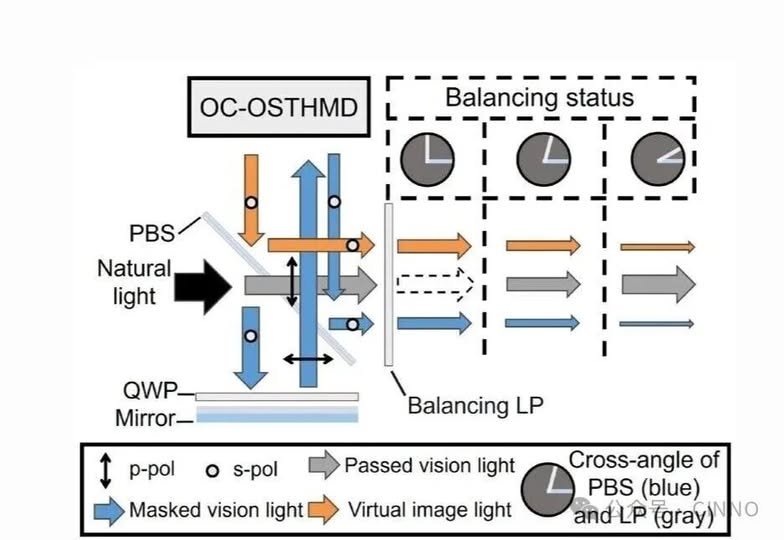
Real occlusion — where virtual objects can actually block real-world ones — is considered essential for believable AR. Without it, a holographic coffee cup sitting on a real table looks like a ghost floating in front of it. But achieving occlusion in optical see-through systems requires polarization processing that strips away enormous amounts of ambient light. Current headsets with occlusion capability sit below 20% theoretical maximum transmittance. Actual built prototypes fare even worse, falling below 7%. In practical terms, that means the world through your AR headset looks like you’re wearing very dark sunglasses — indoors.

This isn’t a software problem. It’s physics. And until now, the workarounds have mostly involved accepting the tradeoff or abandoning true occlusion entirely.

Splitting the Light, Not Losing It

The new approach introduces a rotatable linear polarizer that splits incoming natural light into two separate paths. One path routes through the occlusion optics responsible for rendering virtual imagery. The other bypasses the attenuating elements entirely, preserving full ambient brightness. The ratio between these two paths isn’t fixed — it’s dynamically adjusted in real time using eye tracking and scene-aware visual analysis informed by perceptual models that account for lighting conditions moment to moment.

The elegance here is in what the system doesn’t do: it doesn’t try to brute-force more light through a lossy pipeline. It routes light around the bottleneck when perception allows it.

A Critical Unlock for Consumer and Industrial AR

The implications extend well beyond labs. Outdoor AR use cases — construction, logistics, field service, navigation — have been effectively off the table for occlusion-capable headsets because sunlight exposure makes sub-7% transmittance genuinely dangerous and disorienting. This architecture addresses that constraint directly.

Consumer AR has been caught in a catch-22: users want immersive occlusion, but the brightness penalty makes the experience worse overall. A perceptually-driven balancing system that intelligently trades off occlusion fidelity for usable ambient light could finally break that deadlock.

The research has been published but commercialization timelines remain unspecified. Still, with the findings landing in one of the field’s most respected peer-reviewed venues, the pressure on headset manufacturers to incorporate this kind of optical architecture just increased considerably.


The VR Game That Knows Your Child Is Struggling Before Their Teacher Does
Moonix Bets on Invisibility: AI Glasses That Listen First, Compute Later
A.R. Rahman’s ARR Immersive Brings Kathak and Clair de Lune Into the Apple Vision Pro Era
India’s Shabdalok Museum Brings 380 Languages to Life With AI, AR, and VR
Even Realities Hits $1B Valuation by Betting Smart Glasses Don’t Need a Camera
TAGGED:AR headset technologyaugmented reality displaysdisplay brightness AReye tracking ARlight loss occlusionoptical see-through AR

Sign Up For Daily Newsletter

Be keep up! Get the latest breaking news delivered straight to your inbox.
By signing up, you agree to our Terms of Use and acknowledge the data practices in our Privacy Policy. You may unsubscribe at any time.
Share This Article
Facebook Copy Link Print
Share
Eddie Avil
ByEddie Avil
Co-Founder
Follow:
An XR+Deeptech Evangelist, Podcaster & builder focused on transforming bold ideas into scalable impact. With a sharp eye for innovation and execution, he brings strategic clarity and operational depth to every initiative. His work centers on turning ambition into tangible outcomes that shape industries and communities.
Previous Article Moonix Bets on Invisibility: AI Glasses That Listen First, Compute Later
Leave a Comment

Leave a Reply Cancel reply

Your email address will not be published. Required fields are marked *

Stay Connected

248.1KLike
69.1KFollow
134KPin
54.3KFollow

 banner							
 banner
Create an Amazing Newspaper
Discover thousands of options, easy to customize layouts, one-click to import demo and much more.
Learn More

Latest News

NVIDIA Bets on Ilya Sutskever’s Safety-First AI Lab as the Race to Superintelligence Heats Up
Artificial Intelligence
Mixed Reality Meets the Maternity Ward: Indian Team Completes Landmark Ultrasound Training Platform
XR, VR, AR – XROM
Kimi K3 Is the Open-Source AI Model That Shouldn’t Exist Yet
Artificial Intelligence
Goa Gets Its First VR Science Lab — And It Could Redefine How India Teaches STEM
XR, VR, AR – XROM

Regions

  • Artificial Intelligence
  • XR, VR, AR – XROM
  • Blockchain
  • Quantum & Nanotechnology
  • Robotics & Automation
  • Automotive

You Might also Like

Artificial Intelligence

Train Without Grounding: Parallax Labs Puts Military Aircraft Maintenance Inside a VR Cockpit

Eddie Avil
Eddie Avil
3 Min Read
XR, VR, AR – XROM

Uttar Pradesh Is Putting AR-VR Lounges on Top of Food Trucks — and It Might Just Work

Eddie Avil
Eddie Avil
5 Min Read
Artificial Intelligence

Solos Bets on Two Extremes: A Featherlight Camera-Free AI Glass and a Full-Featured Global Flagship

Eddie Avil
Eddie Avil
5 Min Read
//

We influence 20 million users and is the number one business and technology news network on the planet

Connect

  • About Us
  • Contact
  • Adverstise
  • Events
  • Join Us
  • Member Login
  • My Bookmarks
  • Terms
  • Privacy

Future Tech

  • Artificial Intelligence
  • XR, VR, AR – XROM
  • Blockchain
  • Quantum & Nanotechnology
  • Robotics & Automation
  • Automotive

Science & Discovery

  • Life Sciences & Biotechnology
  • Earth & Environment
  • Health & Medicine
  • Space & Astronomy

Innovation & Industry

  • Startups & Entrepreneurship
  • Policy & Economy
  • Corporate Tech & Semiconductors
  • Telecom & Energy Tech

Regions

  • India
  • North America
  • Europe
  • Asia-Pacific
  • China
  • Latin America
  • Middle East & Africa

Always Stay Up to Date

Subscribe to our newsletter to get our newest articles instantly!
1CW + XROM logo white 1CW + XROM logo white

Follow US   

© 2026 1CW Media Network. All Rights Reserved.

Join Us!
Subscribe to our newsletter and never miss our latest news, podcasts etc..
Zero spam, Unsubscribe at any time.
Welcome Back!

Sign in to your account

Username or Email Address
Password

Lost your password?

Continue with Google
Not a member? Sign Up