




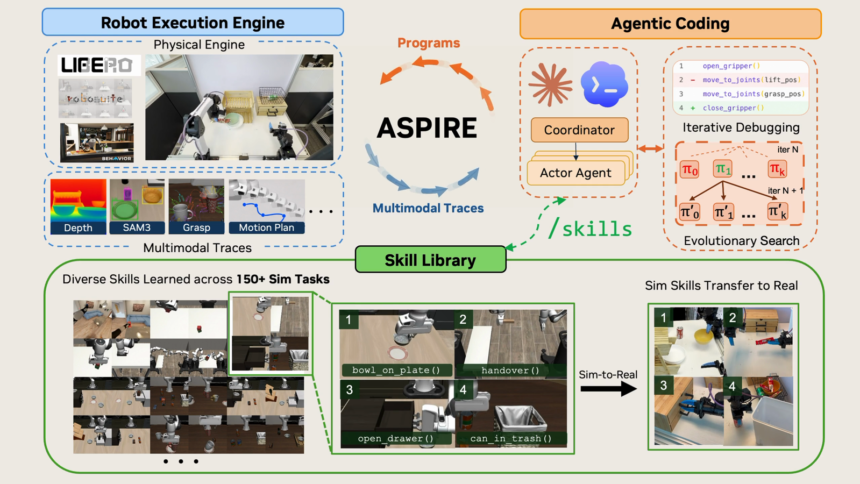
ASPIRE: Agentic/Skills Discovery for Robotics
In a world where robots are increasingly being deployed in complex environments, ensuring they can accurately locate and interact with objects is crucial. This challenge has been tackled by ASPIRE, a system designed to help robots discover their skills autonomously. One of its key components involves the `localize_cube` function, which helps a robot find and identify cubes within an image.
The Localization Function
The `localize_cube` function in ASPIRE’s `cube_stack.py` script is responsible for identifying objects like red and green cubes within a camera feed. It uses a combination of semantic segmentation (via SAM3) and point cloud generation to locate these objects accurately. Here’s how it works:
1. Segmentation**: The image data (`rgb`) is first passed through the Semantic Auto-Encoders Model 3 (SAM3). This model segments the image into different object categories, including red and green cubes.
2. Color Filtering**: SAM3 often confuses red with green due to their similar hues. To address this issue, the function employs a `pick_by_color` method that filters out these ambiguous regions based on predefined thresholds for pixel size (`min_px=50`) and maximum pixels (`max_px=12000`). This ensures only significant object segments are considered.
3. Point Cloud Generation**: Once the segmentation is complete, points in 3D space corresponding to each segment’s location within the camera frame are generated using a `mask_to_world_points` function. These points are then filtered for validity—only those with finite coordinates (no NaN values) are kept.
4. Center Calculation**: To handle any bias caused by cameras facing towards objects, the system calculates the center of mass (`center`) from these valid points. This robust calculation helps in accurately locating the cube’s centroid regardless of camera orientation.
5. Height Estimation**: Finally, the function computes two key heights: `top_z`, which is the 95th percentile value for the z-coordinate (indicating where most of the cube’s upper surface lies), and `bot_z`, representing the 5th percentile height to account for the lower part.
Application in Grasping
With these accurate measurements, ASPIRE can perform precise grasps. For instance, when dealing with a red and green cube, the system calculates their respective centers (`red_c` and `green_c`) and computes the midpoint of their heights (`grasp_z`). This midpoint is used as the target height for the robot’s grasp position.
The process then proceeds to pre-grasp the red cube at this calculated height. If the gripper width isn’t sufficient, ASPIRE will reattempt the grasp before moving on to place the green cube at a new location determined by its own height (`green_top + 0.12`). Finally, it places the green cube in an optimal position using another calculation based on the cube’s height and dimensions.
ASPIRE’s `localize_cube` function exemplifies how AI can empower robots to perform complex tasks with minimal human intervention. By accurately identifying objects like cubes within images, these systems pave the way for more autonomous robotic operations across various industries. As technology continues to evolve, we can expect even greater capabilities in object recognition and manipulation, further enhancing our reliance on intelligent machines.
#AIRevolution #RoboticsTech #ASPIREinnovates #SemanticSegmentation #RoboticLearning #ObjectLocalization #AutonomousSystems