



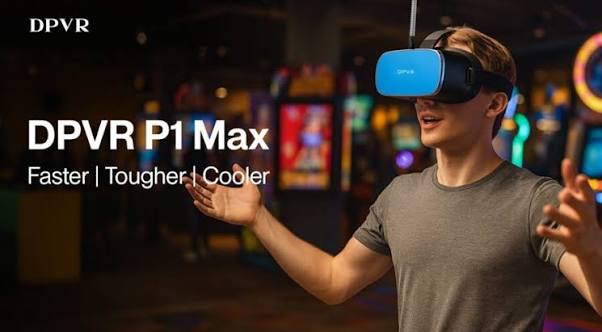
DPVR officially launched its new enterprise standalone headset, the P1
Max, for the commercial market, targeting high-frequency use scenarios such as
offline entertainment venues, vocational education and training, and cultural tourism
experiences.
According to the company, the P1 Max is powered by the Qualcomm Snapdragon
XR2 platform. Its combined CPU, GPU, and AI performance is twice that of the
previous generation, enabling it to smoothly support high-load panoramic interaction,
immersive gaming, and refined instructional content, while ensuring stable long-
duration operation in commercial settings.
In terms of display, the new device supports 8K ultra-high-definition video hardware
decoding, upgrading image quality from the 4K level to the 8K level. It effectively
reduces the screen-door effect and visible graininess, allowing amusement effects,
high-definition video, and precision teaching materials to be rendered with fine detail,
significantly improving user experience and service quality.
To address the common problem of heat buildup during continuous commercial
operation, the P1 Max features a redesigned airflow cooling system. Overall heat
dissipation efficiency has been improved by 50%, enabling stable output under full
load and preventing frequency throttling or app crashes caused by overheating.
In addition, the new headset uses a top direct-power connection channel together with
a durable dedicated cable, effectively solving loosening and power interruption issues
caused by repeated pulling on conventional ports and reducing maintenance failure
rates. It also reserves a Type-C expansion port to support customized development of
modules such as eye tracking, meeting the secondary deployment needs of different
customers.
A DPVR representative said that the core value of commercial VR devices lies in
stability, long service life, and cost-effectiveness. Backed by doubled computing
power, 8K image quality, and efficient heat dissipation, the P1 Max aims to strike a
balance between performance and operating cost, providing low-maintenance, high-
return solutions for the entertainment, education, and cultural tourism sectors.
This release not only enriches DPVR’s enterprise product portfolio, but will also
further consolidate its competitive advantage in the commercial VR market. In the
future, DPVR will continue to rely on its hardware R&D capabilities and deployment
experience to promote deeper adoption of VR technology across more large-scale
application scenarios.