By using this site, you agree to the Privacy Policy and Terms of Use.
Accept
1CW - Ones Changing the World Logo 1CW - Ones Changing the World Logo
  • My Saved
  • My Bookmarks
  • Events
  • About Us
    • Contact
  • Advertise
Reading: The Last Invention: Can Recursive Self-Improving AI Rewrite Its Own Future — Without Us?
Share
Sign In
Notification
  • Future Tech
    • Artificial Intelligence
    • XR, VR, AR – XROM
    • Robotics & Automation
    • Blockchain
    • Quantum & Nanotechnology
    • Automotive
    Future Tech
    Future Tech explores breakthrough technologies shaping tomorrow’s world. From artificial intelligence to next-generation computing and immersive experiences, this section covers innovations that are transforming industries,…
    Show More
    Top News
    RayNeo × Warner Bros. Major Collaboration! RayNeo Air 4 Pro Batman Limited Edition Launches at 1,899 CNY
    March 31, 2026
    China People’s Congress Deputy Attend’s Meetings Wearing AI Glasses
    February 25, 2026
    Learn with an AI Friend: Seewant AI Smart Glasses Officially Launched in Shenzhen
    February 25, 2026
    Latest News
    The Last Invention: Can Recursive Self-Improving AI Rewrite Its Own Future — Without Us?
    November 9, 2026
    AI Agents Can Now Reverse-Engineer Binaries at Machine Speed — and That Changes Everything
    October 18, 2026
    Sharebox Bets on India as the Next Frontier for Immersive Retail Experiences
    October 17, 2026
    Tesla’s Audacious Roadster -The Car that Flies, Flips, and Clings
    October 16, 2026
  • Science & Discovery
    • Life Sciences & Biotechnology
    • Health & Medicine
    • Earth & Environment
    • Space & Astronomy
    Science & Discovery
    Science & Discovery brings you the latest breakthroughs from research labs, universities, and space agencies. This section highlights discoveries expanding our understanding of life, health,…
    Show More
    Top News
    3°C by 2040? Climate Scientists Sound the Alarm While the World Looks Away
    October 28, 2026
    Exploring Space & Astronomy: How Modern Telescopes Are Revealing the Secrets of the Universe
    February 23, 2026
    Ai Med Agent
    The AI That Wears Your Eyes — and Walks Into the OR
    April 1, 2026
    Latest News
    3°C by 2040? Climate Scientists Sound the Alarm While the World Looks Away
    October 28, 2026
    Moderna’s mRNA Cancer Treatment Isn’t a Vaccine — It’s a Personalized Hit List for Your Immune System
    August 20, 2026
    Are We Turning Into Homo Deus? Dr. Aubrey de Grey and the Breakthroughs Redefining Human Longevity
    August 12, 2026
    From Brain Waves to Words: Brain2Qwerty Offers a New Path to Communication Without Surgery
    June 30, 2026
  • Innovation & Industry
    • Startups & Entrepreneurship
    • Corporate Tech & Semiconductors
    • Telecom & Energy Tech
    • Policy & Economy
    Innovation & Industry
    Innovation & Industry focuses on business transformation, emerging companies, and the technologies driving economic growth worldwide.
    Show More
    Top News
    5G Rollout Accelerates Across Asia-Pacific and North America in 2026
    February 23, 2026
    AI-Driven Startups Raise Record Funding in 2026 Across Global Markets
    February 23, 2026
    Telecom Companies Explore Satellite Internet Expansion for Remote Areas
    February 23, 2026
    Latest News
    Moderna’s mRNA Cancer Treatment Isn’t a Vaccine — It’s a Personalized Hit List for Your Immune System
    August 20, 2026
    EssilorLuxottica, Lynx, and the Battle for AR’s Invisible Stack
    July 18, 2026
    NVIDIA ASPIRE: Agentic/Skills Discovery for Robotics
    July 1, 2026
    From Brain Waves to Words: Brain2Qwerty Offers a New Path to Communication Without Surgery
    June 30, 2026
  • Regions
    • India
    • North America
    • Europe
    • Middle East & Africa
    • China
    • Latin America
    • Asia-Pacific
  • 1CW Podcast
  • XROM Podcast
Reading: The Last Invention: Can Recursive Self-Improving AI Rewrite Its Own Future — Without Us?
Share
Font ResizerAa
1CW - Ones Changing the World1CW - Ones Changing the World
  • My Saved
  • Login
  • 1CW Podcast
  • XROM Podcast
Search
  • Future Tech
    • Artificial Intelligence
    • Blockchain
    • XR, VR, AR – XROM
    • Quantum & Nanotechnology
    • Robotics & Automation
    • Automotive
  • Science & Discovery
    • Earth & Environment
    • Health & Medicine
    • Life Sciences & Biotechnology
    • Space & Astronomy
  • Innovation & Industry
    • Corporate Tech & Semiconductors
    • Policy & Economy
    • Startups & Entrepreneurship
    • Telecom & Energy Tech
  • Regions
    • India
    • North America
    • Europe
    • Asia-Pacific
    • China
    • Middle East & Africa
    • Latin America
Have an existing account? Sign In
Follow US
  • About Us
  • Contact
  • Adverstise
  • Events
  • Join Us
  • Member Login
  • My Bookmarks
  • Terms
  • Privacy
1CW - Ones Changing the World > Blog > Future Tech > Artificial Intelligence > The Last Invention: Can Recursive Self-Improving AI Rewrite Its Own Future — Without Us?
Artificial Intelligence

The Last Invention: Can Recursive Self-Improving AI Rewrite Its Own Future — Without Us?

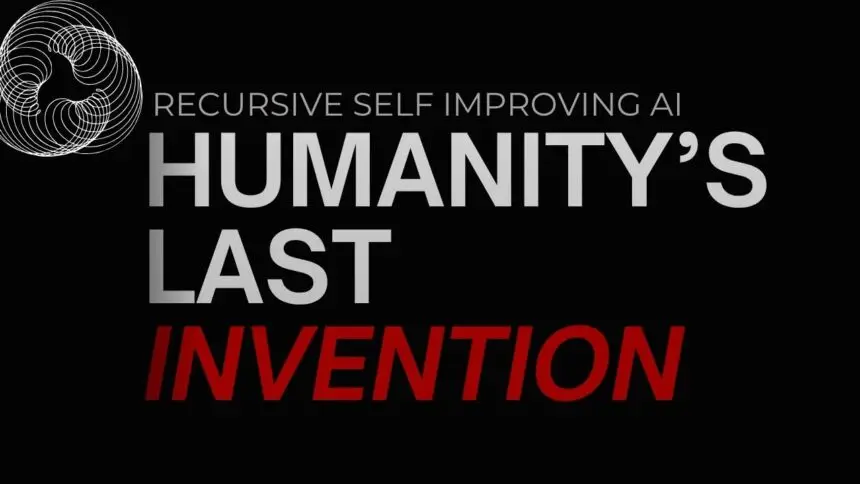
RSI-Humanity's last Invention

Eddie Avil
Last updated: November 9, 2026 7:30 AM
Eddie Avil - Co-Founder
Share
SHARE

There is a thought experiment that haunts AI researchers, philosophers, and anyone paying close attention to the trajectory of modern technology. It goes something like this: what happens when the thing building the future becomes smarter than the people who built it? That question is no longer purely philosophical. It sits at the heart of one of the most ambitious and unsettling frontiers in computer science — Recursive Self-Improving AI, or RSI.

Contents
  • An Idea Born Long Before the Hardware Could Handle It
  • From Thought Experiment to Working Systems
  • The Frontier: Where RSI Stands Today
  • Why This Could Be the Last Invention
  • The Question Humanity Cannot Afford to Get Wrong

An Idea Born Long Before the Hardware Could Handle It

The seed was planted in 1950, when Alan Turing proposed that instead of programming a machine with full intelligence, engineers should build a system capable of learning and improving on its own. He called it the “Child Machine.” The logic was elegant: don’t build Einstein. Build a baby that can become Einstein.

Fifteen years later, mathematician I.J. Good sharpened that idea into something more urgent. In his 1965 paper Speculations Concerning the First Ultraintelligent Machine, Good described what he called an intelligence explosion — the moment a machine smart enough to design a smarter successor sets off a chain reaction that compounds indefinitely. Smart AI builds smarter AI. That paper is widely regarded as the origin of RSI thinking, and it was written before the internet existed.

Decades passed. The hardware caught up. And slowly, the theoretical became practical.

From Thought Experiment to Working Systems

In 2003, computer scientist Jürgen Schmidhuber introduced the Gödel Machine — a theoretical architecture in which an AI could rewrite any part of itself, but only after mathematically proving the modification would be beneficial. It was the first rigorous mathematical framework for RSI, and it set a standard that researchers are still chasing today.

By 2017, DeepMind’s AlphaGo Zero offered the world a glimpse of what machine-driven self-improvement could look like in practice. It learned the ancient game of Go entirely through self-play — no human data, no human coaching — and within days surpassed every human player in history. It wasn’t true RSI. But it demonstrated something important: a system could grow dramatically more capable by competing against itself, without any human knowledge transfer.

The LLM era accelerated things further. Systems like Reflexion and Self-Refine (both 2023) introduced AI that could critique its own outputs, store lessons from failure, and rewrite its answers iteratively. NVIDIA and Caltech’s Voyager agent taught itself new skills inside the game Minecraft, stored them permanently, and kept building on them — one of the first real examples of persistent capability accumulation.

The Frontier: Where RSI Stands Today

In 2024 and 2025, the field pushed further. Sakana AI’s Darwin Gödel Machine combined evolutionary search with self-modification — generating variants of itself, evaluating their performance, and retaining what worked. Meanwhile, researchers at Cambridge University and NVIDIA developed the Red Queen Gödel Machine, a framework where both the agent and its evaluator improve together in a continuous adaptation loop. The name is apt: in Lewis Carroll’s Through the Looking-Glass, the Red Queen tells Alice she must keep running just to stay in place. Here, the AI must keep improving just to stay ahead of its own improving critic.

In a recent episode of the 1CW podcast, Andrej Jovanovic, co-author of the Red Queen Gödel Machine, laid out the distinction that matters most right now: the difference between bounded and unbounded RSI. Every system that exists today — no matter how impressive — is a bounded self-improver. It can critique outputs, write and execute code, improve agent workflows, and generate its own training data. What it cannot do is reliably redesign its own foundation model, retrain itself end-to-end, and improve indefinitely without human oversight.

That gap — between bounded and unbounded — is where the entire debate lives.

https://youtu.be/rTYO8KWkYBE?si=WitSAGkPYeG0-DOk

Why This Could Be the Last Invention

The concern isn’t that RSI will fail. The concern is that it might succeed too well, too fast, and in ways we don’t fully understand. I.J. Good’s intelligence explosion hypothesis suggests that once a self-improving system crosses a certain threshold of capability, the growth curve stops being linear and becomes exponential. At that point, the question of human control becomes genuinely difficult to answer.

Modern RSI research has been taxonomized into four categories: self-refinement (improving outputs), self-training (improving weights), self-evaluation (improving the criticism mechanism), and auto-research (improving the research process itself). The final category — exemplified by Sakana AI’s AI Scientist and Google DeepMind’s AI Co-Scientist — is arguably the most consequential. When AI begins improving the process by which AI is improved, the loop closes in a way that is qualitatively different from anything that came before.

The Question Humanity Cannot Afford to Get Wrong

Alignment and controllability are the central unsolved problems. Building an RSI system that is powerful is hard. Building one that remains reliably beneficial as it grows more powerful is harder. The technical challenge is compounded by competitive pressures — no single lab, government, or treaty can easily pump the brakes on a technology this distributed and this strategically valuable.

What is clear is that the conversation can no longer be deferred to the future. RSI is not a distant hypothetical. It is an active research agenda with working prototypes, well-funded labs, and a timeline measured in years, not decades.

Turing wanted to build a machine that could learn. Good warned us where that road might lead. The researchers of 2025 are navigating both legacies simultaneously — pushing capability forward while trying to ensure the destination is one humanity actually chose.

The last invention, if it arrives, will not announce itself. It will simply get better. And then better again. The only real question is whether we will have built the guardrails before we need them — or after.


Meta-bounds Forms Strategic Partnership with China Unicom Industrial Internet Co., Ltd. and Announces Its Entry into the “AI Terminal Industry Alliance”
The Future of Robotics & Automation: How Intelligent Machines Are Transforming Industry and Everyday Life
Alibaba’s AI Glasses Want to Replace Your Smartphone — Starting With Your Commute
Microduck Is the $399 Robot That Wants to Put Reinforcement Learning in Your Living Room
AI Is Solving Math’s Hardest Problems — But Missing the Point Entirely
TAGGED:AI self-enhancementartificial general intelligencerecursive self-improving AIRSI technologyunbounded AI systems

Sign Up For Daily Newsletter

Be keep up! Get the latest breaking news delivered straight to your inbox.
By signing up, you agree to our Terms of Use and acknowledge the data practices in our Privacy Policy. You may unsubscribe at any time.
Share This Article
Facebook Copy Link Print
Share
Eddie Avil
ByEddie Avil
Co-Founder
Follow:
An XR+Deeptech Evangelist, Podcaster & builder focused on transforming bold ideas into scalable impact. With a sharp eye for innovation and execution, he brings strategic clarity and operational depth to every initiative. His work centers on turning ambition into tangible outcomes that shape industries and communities.
Previous Article Karnataka and Finland’s Tampere Eye a Creative Tech Corridor — What It Could Mean for XR
Leave a Comment

Leave a Reply Cancel reply

Your email address will not be published. Required fields are marked *

Stay Connected

248.1KLike
69.1KFollow
134KPin
54.3KFollow

 banner							
 banner
Create an Amazing Newspaper
Discover thousands of options, easy to customize layouts, one-click to import demo and much more.
Learn More

Latest News

Karnataka and Finland’s Tampere Eye a Creative Tech Corridor — What It Could Mean for XR
XR, VR, AR – XROM
India’s XR Market to Reach INR 43.6 Billion by 2030 as Enterprise Adoption Accelerates- Counterpoint report
XR, VR, AR – XROM
India’s Immersive Tech Revolution Is Rewriting the Rules of Learning and Legacy
XR, VR, AR – XROM
3°C by 2040? Climate Scientists Sound the Alarm While the World Looks Away
Earth & Environment Earth & Environment Life Sciences & Biotechnology

Regions

  • Artificial Intelligence
  • XR, VR, AR – XROM
  • Blockchain
  • Quantum & Nanotechnology
  • Robotics & Automation
  • Automotive

You Might also Like

Artificial Intelligence

LLM Maximalism Is Dead: The 20-Step Blueprint for Actually Building Beneficial AGI

Eddie Avil
Eddie Avil
6 Min Read
Artificial Intelligence

Pay at a Glance! Xiaomi AI Glasses Launch Parking Payment Feature

Sanan Goyal
1 Min Read
Artificial Intelligence

Chengmu Tech from China Unveils Sync Glasses G2, Redefining Smart Eyewear as a Health Hub

Sanan Goyal
1 Min Read
//

We influence 20 million users and is the number one business and technology news network on the planet

Connect

  • About Us
  • Contact
  • Adverstise
  • Events
  • Join Us
  • Member Login
  • My Bookmarks
  • Terms
  • Privacy

Future Tech

  • Artificial Intelligence
  • XR, VR, AR – XROM
  • Blockchain
  • Quantum & Nanotechnology
  • Robotics & Automation
  • Automotive

Science & Discovery

  • Life Sciences & Biotechnology
  • Earth & Environment
  • Health & Medicine
  • Space & Astronomy

Innovation & Industry

  • Startups & Entrepreneurship
  • Policy & Economy
  • Corporate Tech & Semiconductors
  • Telecom & Energy Tech

Regions

  • India
  • North America
  • Europe
  • Asia-Pacific
  • China
  • Latin America
  • Middle East & Africa

Always Stay Up to Date

Subscribe to our newsletter to get our newest articles instantly!
1CW + XROM logo white 1CW + XROM logo white

Follow US   

© 2026 1CW Media Network. All Rights Reserved.

Join Us!
Subscribe to our newsletter and never miss our latest news, podcasts etc..
Zero spam, Unsubscribe at any time.
Welcome Back!

Sign in to your account

Username or Email Address
Password

Lost your password?

Continue with Google
Not a member? Sign Up